Today’s technical systems contain more and more components which are typically networked and interacting with each other. So, these systems become very complex, which makes it difficult to engineer and maintain the system using traditional, hierarchical approaches.
Looking into complex systems in nature, we see that they are controlled by distributed self-organizing mechanisms that are simple, scalable, robust, and adaptive. However, putting a self-organizing approach into technical systems is not straightforward, because such complex systems are typically hard to predict. A particular change in an interaction mechanism might even have counter-intuitive effects.
In nature, the driving mechanism behind building self-organizing behavior is evolution - why not use the very same method in form of an evolutionary algorithm?
However, there is a need to integrate different tools and models like neural networks, mutation and recombination, and problem-specific simulations. With our tool FREVO we provide a unifying framework to reduce this problem to basically three components: a problem representation, an agent representation and an evolutionary algorithm.
FREVO has been used to solve quite different problems and is available as open source to everyone. It is a very flexible framework open to new components and simulations, thus, we are looking forward to see you testing your ideas with it :-)
This talk was given by István Fehérvári at FET 2011 in the science café. This work was supported in part by the Lakeside Labs project MESON (Modeling and Engineering of Self-Organizing Networks) and the Lakeside Labs GmbH.
Tuesday, September 27, 2011

Thursday, September 22, 2011
Replacing the Java random generator
The Java random number generator was implemented in 1995. It is based on a linear congruential generator. Since then, there was considerable advancement in algorithms for pseudo random number generators. For most applications, Java's random number generator might be sufficient, but at a closer look, the algorithm has a fairly short period of 248 and fails some tests on the randomness of its output.
The good news is that there is an algorithm which is faster and better: the Xorshift algorithm. Xorshift is using a few (in the following implementation exactly three) of shift and exclusive-or operations. The best way to integrate it to Java is to make a subclass of java.util.random and to overwrite the
Since all methods of the Random generator (
A complete Java class including also a
This implementation is about 30% faster than the generator from java.util.random. It's output passes the Dieharder test suite with no fail and only two announced weaknesses. To use the class in legacy code, you may also instantiate an
The good news is that there is an algorithm which is faster and better: the Xorshift algorithm. Xorshift is using a few (in the following implementation exactly three) of shift and exclusive-or operations. The best way to integrate it to Java is to make a subclass of java.util.random and to overwrite the
seed variable and the next() method:import java.util.Random;
/**
* A subclass of java.util.random that implements the
* Xorshift random number generator
*/
public class XSRandom extends Random {
private long seed;
public XSRandom(long seed) {
this.seed = seed;
}
protected int next(int nbits) {
long x = seed;
x ^= (x << 21);
x ^= (x >>> 35);
x ^= (x << 4);
seed = x;
x &= ((1L << nbits) - 1);
return (int) x;
}
}
Since all methods of the Random generator (
nextBoolean(), nextInt(), nextLong(), nextFloat(), nextDouble()), nextBytes(), nextGaussian()) depend on the next() method, this efficiently changes all number generation to the Xorshift algorithm.A complete Java class including also a
clone() method can be downloaded here (Code is under LGPL Version 3). Note that this implementation, unlike the java.util.Random is not exactly thread-safe - concurrent threads might access and change the seed variable inconsistently. However, note that concurrent access on the same random object would anyway end up in a nondeterminstic sequence of numbers for each thread.This implementation is about 30% faster than the generator from java.util.random. It's output passes the Dieharder test suite with no fail and only two announced weaknesses. To use the class in legacy code, you may also instantiate an
XSRandom object and assign it to a java.util.Random variable: java.util.Random rand = new XSRandom();Tuesday, September 20, 2011
Pseudo random number generators

Many computer programs, like for example games or Monte Carlo simulation require a random function. Typically, a computer operating on defined binary states that only change at particular clock instants has no true randomness - its operations are deterministic. So, typically pseudo random number generators are used to generate number sequences similar to random ones.
In 1946, John von Neumann suggested such an algorithm named the middle-square method. Von Neumann's algorithm is simple: take a number as the "seed", square it, remove the middle digits of the resulting number (when viewed in decimal format) and take the remaining digits as your "random number". This number becomes also the new seed. The algorithm is fast, but statistic tests on the generated random numbers show that the distribution of numbers significantly differs from true random numbers. Worse, once the seed becomes zero, the algorithm gets stuck.
A few decades after Neumann, the programming language C came with a library function for generating random numbers using the functions rand (to pull a number) and srand (to set the seed). For generating one number, the algorithm linearly combines several terms based on constants derived from the seed. This means a higher implementation effort, but the test passes most statistical tests on randomness, such as for example are given ba the Dieharder random test suite.
The famous home computer Commodore 64 had a different algorithm for random number generation, which was simpler: The last seed is multiplied with a big number, a small number is added and the resulting number (given in a floating point format) is mixed up by switching bytes. Although the C64 algorithm was considered practically useful in a publication from Bowman, the Diehard test quickly shows a lot of deficiencies of the algorithm.
In 1997, Makoto Matsumoto and Takuji Nishimura came up with a very good algorithm, the Mersenne Twister. While this algorithm passes most of the Dieharder tests, the implementation has also grown in its complexity. For example, a common implementation of the algorithm requires an array of 624 numbers.
So - do you think now there is a tradeoff between quality of randomness and computation effort? Wrong!
The late (and great) George Marsaglia showed us a simple way to generate high quality numbers: the Xorshift algorithm.
public long randomLong() {
  x ^= (x << 21);
  x ^= (x >>> 35);
  x ^= (x << 4);
  return x;
}
The computational effort of the algorithm is obviously very low. If you chose "good" values for the three magic numbers (e.g., 21, 35, 4 as in the above example) Xorshift passes the Diehard tests.
As it is the case in many complex systems, there is a simple way to control the systems behavior as intended, but is very difficult to find that simple way. In the case of pseudo random numbers it took 60 years from John von Neumann's middle-square to George Marsaglia's Xorshift.
- J. von Neumann. "Various techniques used in connection with random digits", in A.S. Householder, G.E. Forsythe, and H.H. Germond, eds., Monte Carlo Method, National Bureau of Standards Applied Mathematics Series, 12:36-38, reprinted 1951.
- M. Matsumoto and T. Nishimura. "Mersenne twister: a 623-dimensionally equidistributed uniform pseudo-random number generator". ACM Transactions on Modeling and Computer Simulation 8(1):3–30, 1998
- R. Bowman. Evaluating Pseudo-Random Number Generators. Comput. &amb; Graphics, Vol. 19, No. 2, pp. 315-324, 1995.
- G. Marsaglia. "Xorshift RNGs". Journal of Statistical Software Vol. 8 No. 14, 2003.
Wednesday, September 7, 2011
Langton's Ant - from simple rules to complex behavior
The following system is created using a very simple set of rules:
Despite the simple rules, the ant is following an interesting and unexpected path. This relates to what Carlos Gershenson has pointed out in his blog: a deterministic system does not necessarily mean that it is predictable. A system is deterministic if no randomness is involved in the development of future states of the system. Thus, given a particular starting condition, the system will always develop its future states in the same way. The real physical world, considering the randomness in quantum effects, is not deterministic. But the simulated ant in our example is. On the other hand, prediction means the ability to make a forecast of a system's state (either qualitatively or quantitatively). These two terms represent different concepts and should not be mixed up.

In our deterministic ant system, it is not possible to predict the behavior by looking at the rules unless you have tried out the simulation beforehand. Although we have just one agent, we face a complex system, since the agent is interacting with every single cell it arrives. And each move changes the cell and orientation, thus creates new information. The interesting and unexpected thing is what the ant is doing after roughly 10200 steps. Until then the movement is chaotic. But subsequently, the ant produces a "highway" by walking away to the south-east in repeated sequences of 104 steps. From that point on, the future system states can be predicted for all future states.
If you liked this, check out the work of Propp et al. on Langton's ants with multiple grid colors. They present a three-color model where it is not known if the ant will ever enter a stage producing a predictable highway. So far on deterministic models - in your face, predictability!
- Let's assume an infinite 2D grid world. Each grid cell can be either black or white.
- For simplicity, all grid cells are white at the beginning.
- There is an ant, which can move up to four directions (N,E,S,W).
- Whenever the ant enters a white field, it toggles the grid color and performs a clockwise (right) turn.
- Whenever the ant enters a black field, it toggles the grid color and performs a counter-clockwise (left) turn.
Despite the simple rules, the ant is following an interesting and unexpected path. This relates to what Carlos Gershenson has pointed out in his blog: a deterministic system does not necessarily mean that it is predictable. A system is deterministic if no randomness is involved in the development of future states of the system. Thus, given a particular starting condition, the system will always develop its future states in the same way. The real physical world, considering the randomness in quantum effects, is not deterministic. But the simulated ant in our example is. On the other hand, prediction means the ability to make a forecast of a system's state (either qualitatively or quantitatively). These two terms represent different concepts and should not be mixed up.

In our deterministic ant system, it is not possible to predict the behavior by looking at the rules unless you have tried out the simulation beforehand. Although we have just one agent, we face a complex system, since the agent is interacting with every single cell it arrives. And each move changes the cell and orientation, thus creates new information. The interesting and unexpected thing is what the ant is doing after roughly 10200 steps. Until then the movement is chaotic. But subsequently, the ant produces a "highway" by walking away to the south-east in repeated sequences of 104 steps. From that point on, the future system states can be predicted for all future states.
If you liked this, check out the work of Propp et al. on Langton's ants with multiple grid colors. They present a three-color model where it is not known if the ant will ever enter a stage producing a predictable highway. So far on deterministic models - in your face, predictability!
- Langton's ant@Wikipedia
- Gale, D.; J. Propp, S. Sutherland, S.Troubetzkoy, Further Travels with My Ant. Mathematical Entertainments column, Mathematical Intelligencer 17: 48–56, 1995.
- Carlos Gershenson, Determinism != Predictability, Complexes Blog, September, 2010
Thursday, August 11, 2011
Science beyond Fiction - A visit at FET 2011
The European Future Technologies Conference FET is a bi-annual cross-disciplinary conference for frontier research in Europe.
I visited the conference for the second time (last time in 2009 in Prague). This year in Budapest, topics covered robotics, complexity, evolutionary computation and brain research. But, the most entertaining part of this conference are always the exhibitions.
The video gives a short 2-minutes tour through the stations that impressed me the most:
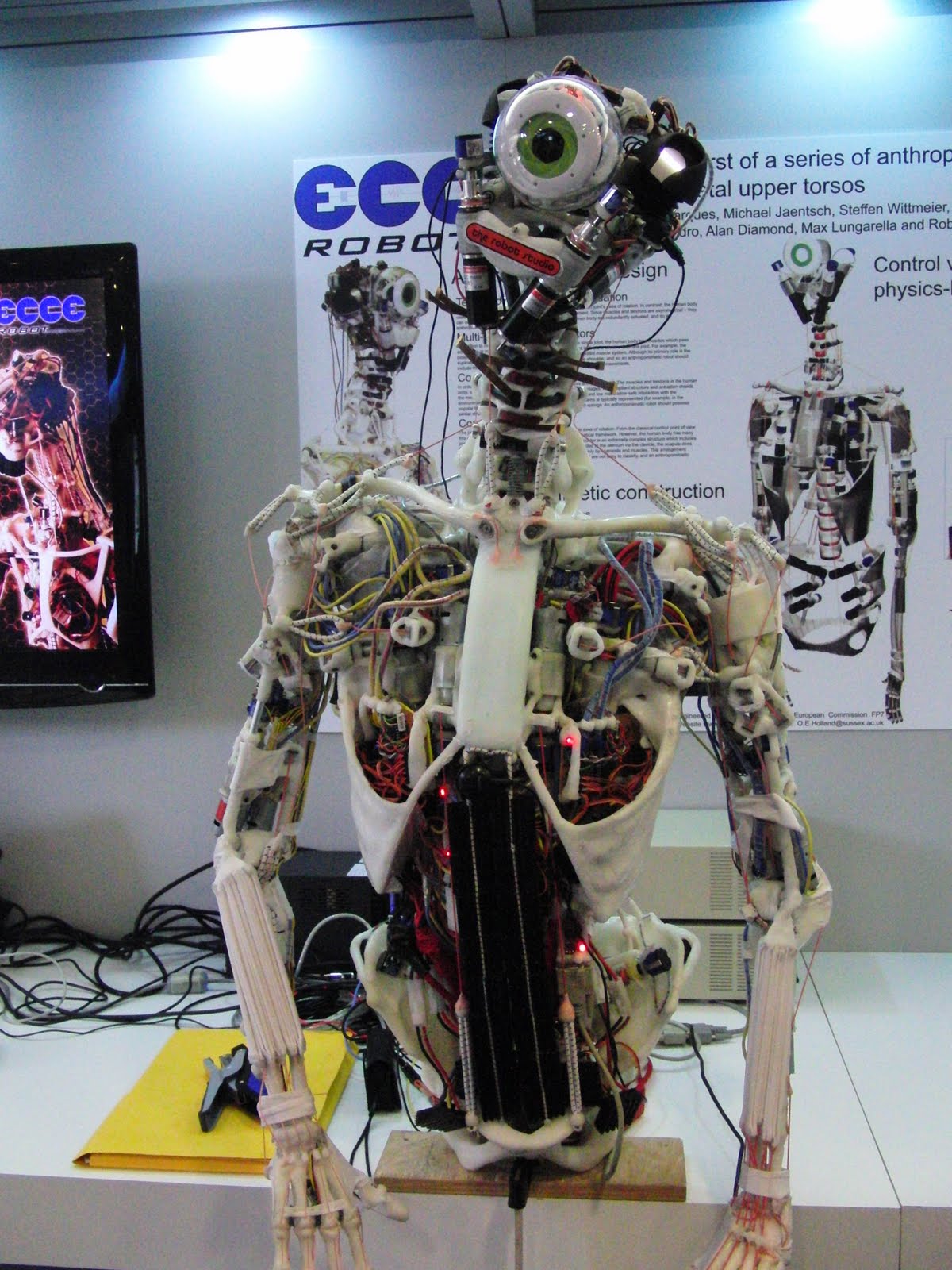
 In the beginning you see a cyclops bot, the ECCE1: the first of a series of anthropomimetic musculoskelal upper torsos. That means its torso is designed to look very human-like, together with the noises from the servos it gives me quite a Terminator feeling (compare it to the ending scene of Terminator 1 movie if you don't believe me). This impression is reinforced by the calculations and identification routines that run down the computer screen while the bot is focusing on you to give you a tight handshake-
Our contribution to the conference was Istváns talk on "Complexity on the workbench" in the science cafe. Istvan had 20 x 20 seconds to present his ideas, where he started with the complexity problem, lead over to possible approaches to build complex self-organizing control systems and finally introduced our framework Frevo from our project MESON as a hands-on tool to practically build such systems.
 Next station is the artificial eel bot that is moving around in a water bassin. A nice example of bio-inspired engineering. Still I hope that they don't make it a tool like a colonoscope out of it - just too creepy :-)
The cooperating robots had an interesting setup - the composition of ground robots, a flying multicopter and a robot that can lift itself up a rope. In cooperation, the bots could for example find, grab and fetch a particular book from a shelf. This will save me the way to the library in the future :-)
 Another bio-inpired research is on octopus limbs. The biological ones are amazing regarding their adaptibility in length and thickness and their strength. Several research group investigate how these mechanisms can be converted to a technology for robot manipulators. In the video, you can see a first prototype.
 The elected winner of the exhibition, was "the future of biomimetic machines", featuring iCub, a humanoid robot used as a platform to study perception and learning processes. In the video, you can see the cute robot following and catching a ball. Considering that the winner at FET'09 was a project featuring a Nao robot, one can conclude: "cuteness wins" :-)
Neither cute nor creepy are the robots from the SYMBRION/REPLICATOR project - they are whatever you want them to be. In the video you can see several parts assembling themselves, very impressive, although the docking mechanism still needs a bit of tuning.
These have been a selection out of approximately 30 demonstrations at FET'11. If you are more interested, go an visit FET next time for yourself, see you there :-)
I visited the conference for the second time (last time in 2009 in Prague). This year in Budapest, topics covered robotics, complexity, evolutionary computation and brain research. But, the most entertaining part of this conference are always the exhibitions.
The video gives a short 2-minutes tour through the stations that impressed me the most:
Our contribution to the conference was Istváns talk on "Complexity on the workbench" in the science cafe. Istvan had 20 x 20 seconds to present his ideas, where he started with the complexity problem, lead over to possible approaches to build complex self-organizing control systems and finally introduced our framework Frevo from our project MESON as a hands-on tool to practically build such systems.

The cooperating robots had an interesting setup - the composition of ground robots, a flying multicopter and a robot that can lift itself up a rope. In cooperation, the bots could for example find, grab and fetch a particular book from a shelf. This will save me the way to the library in the future :-)


Neither cute nor creepy are the robots from the SYMBRION/REPLICATOR project - they are whatever you want them to be. In the video you can see several parts assembling themselves, very impressive, although the docking mechanism still needs a bit of tuning.
These have been a selection out of approximately 30 demonstrations at FET'11. If you are more interested, go an visit FET next time for yourself, see you there :-)
Thursday, June 16, 2011
Open PhD Position in Complex Systems
 |
| It could be you! |
Potential candidates should have a master's degree in computer science, computer engineering, mathematics, physics or related studies and should have skills in creative problem solving, Java programming, the use of the English language and knowledge in at least one of the following subjects:
- Complex systems, or
- Machine Learning, or
- Multi-agent systems, or
- Robotics
Saturday, May 28, 2011
Cake paradox resolved - an excursion into Game Theory
In the last posting we elaborated the cake paradox. In short, if we agree to bring in a cake on any day within the following week, Friday (the last day) is not a good choice, because then, the people can predict this already after there was no cake until Thursday. Iterating this argument we end up that no day is good for a surprise.
Actually, we need to clarify certain things in the model here. First, a situation where one is expecting a cake, but it is not brought is also a kind of surprise, though a disappointing one.
Second, if the colleagues are forced to choose one day, the odds are simply 1 out of 5 to guess the day right. Waiting until Thursday to place the bet does not help the guesser here, because in this case you have a high chance to have already lost because the cake was brought before.
However, the game becomes interesting, if the colleagues get the possibility to put a bet on a day at any time before that day but making betting optional. So if you are a cautious person, you might not bet at all, or would wait until Thursday evening, and place the sure bet in case the was not brought before. What is the best strategy for this set up?
Let's look at the payoff table for a situation where only Thursday and Friday are left, the cake has not been brought in yet and no bet was made so far. Player A has to bring in the cake, while player B tries to place the bet.
This situation has no pure-strategy Nash Equilibrium. For the best mixed strategy, Player A should chose Thursday with a probability of 2/3, otherwise Friday. In contrast, Player B's best strategy is to bet on Friday with a probability of 2/3. The expected payoff for Player A is then -1/3, which means an advantage for B.
Now we can set up a payout table for the "Wednesday or Later" game. The "Later"-Payoff in the case that neither the cake has been brought yet nor Player B has used her bet so far is the 1/3 derived from the previous payout table.
This way we can iterate the game until we end up on Monday. Assuming optimum mixed strategies, the best strategy for Player A to bring in the cake calculates to
16/31 for Monday
8/31 for Tuesday
4/31 for Wednesday
2/31 for Thursday
and 1/31 for Friday.
The guessing player has the same probabilities but increasing from 1/31 for Monday until 16/31 for Friday because the chances favor the guesser towards the end of the week. These mixed strategies establish a Nash equilibrium, thus none of the players has a benefit on changing the strategy. In overall, the game slightly favors the guesser, who is expected to win 3% more often.
Now, we earned ourselves a cake - bon appetit!
Actually, we need to clarify certain things in the model here. First, a situation where one is expecting a cake, but it is not brought is also a kind of surprise, though a disappointing one.
Second, if the colleagues are forced to choose one day, the odds are simply 1 out of 5 to guess the day right. Waiting until Thursday to place the bet does not help the guesser here, because in this case you have a high chance to have already lost because the cake was brought before.
However, the game becomes interesting, if the colleagues get the possibility to put a bet on a day at any time before that day but making betting optional. So if you are a cautious person, you might not bet at all, or would wait until Thursday evening, and place the sure bet in case the was not brought before. What is the best strategy for this set up?
Let's look at the payoff table for a situation where only Thursday and Friday are left, the cake has not been brought in yet and no bet was made so far. Player A has to bring in the cake, while player B tries to place the bet.
| Player A brings cake on Thursday | Player A brings cake on Friday | |
| Player B places bet on Thursday | (-1,1) Player B guessed it right | (1,-1) Player B guessed it wrong |
| Player B waits and eventually places bet on Friday | (0,0) No bet was placed, game is over (because cake is there) | (-1,1) Player B guessed it right |
This situation has no pure-strategy Nash Equilibrium. For the best mixed strategy, Player A should chose Thursday with a probability of 2/3, otherwise Friday. In contrast, Player B's best strategy is to bet on Friday with a probability of 2/3. The expected payoff for Player A is then -1/3, which means an advantage for B.
Now we can set up a payout table for the "Wednesday or Later" game. The "Later"-Payoff in the case that neither the cake has been brought yet nor Player B has used her bet so far is the 1/3 derived from the previous payout table.
| Player A brings cake on Wednesday | Player A brings cake later | |
| Player B places bet on Wednesday | (-1,1) Player B guessed it right | (1,-1) Player B guessed it wrong |
| Player B waits | (0,0) No bet was placed, game is over (because cake is there) | (1/3,-1/3) Game defaults to previous situation |
This way we can iterate the game until we end up on Monday. Assuming optimum mixed strategies, the best strategy for Player A to bring in the cake calculates to
16/31 for Monday
8/31 for Tuesday
4/31 for Wednesday
2/31 for Thursday
and 1/31 for Friday.
The guessing player has the same probabilities but increasing from 1/31 for Monday until 16/31 for Friday because the chances favor the guesser towards the end of the week. These mixed strategies establish a Nash equilibrium, thus none of the players has a benefit on changing the strategy. In overall, the game slightly favors the guesser, who is expected to win 3% more often.
Now, we earned ourselves a cake - bon appetit!
- Strategies in Game Theory@Wikipedia
- Nash Equilibrium@Wikipedia
- Unexpected hanging paradox@Wikipedia
Subscribe to:
Posts (Atom)