Showing posts with label biology. Show all posts

Friday, December 1, 2023

A Slime Mold Algorithm for Repairing a Power Transmission Network after an Electromagnetic Pulse Attack


After an extensive journey of in-depth exploration, spanning literature review, hypothesis formulation, modeling, implementation, and many weeks of simulation, Kristina Wogatai proudly presented her paper, "A Graph-Based Approach for Applying Biologically-Inspired Slime Mold Algorithms for Repairing a Power Transmission Network after an Electromagnetic Pulse Attack," at the 2nd International Conference on Power Systems and Electrical Technology (PSET) in Milan, Italy, held from August 25th to 27th, 2023. The paper, authored by Kristina Wogatai, Johannes Winkler, and Wilfried Elmenreich, explores how to apply slime mold algorithms to restore power grids after an electromagnetic pulse (EMP) attack.

Our proposed method intricately utilized a simulated slime mold algorithm on graph models to pinpoint critical repair areas, drawing inspiration from how slime molds construct networks between food sources. These single-celled organisms, known for their intelligent swarm behavior, have inspired algorithms addressing optimization problems and the creation of efficient transportation networks. Our open-source algorithm, SISMO (Simulation of Slime Molds), has contributed to this work.

Adapting the SISMO algorithm for connecting power stations and plants required overcoming challenges, such as incorporating geographic or demographic criteria for power line placement. Initially provided only with the positions of power stations, we addressed this problem by leveraging graph visualization algorithms like Force Atlas, Force Atlas2, and Yifan-Hu to modify the layout and thus communicate these parameters to the algorithm effectively.


Our efforts did not go unnoticed, as Kristina received the Best Oral Presentation Award at the conference, emphasizing the paper's quality and the significance of its findings in power network restoration.

For further information, check out the paper

Kristina Wogatai, Johannes Winkler, and Wilfried Elmenreich. A Graph-Based Approach for Applying Biologically-Inspired Slime Mold Algorithms for Repairing a Power Transmission Network after an Electromagnetic Pulse Attack. In Proc. 2023 2nd International Conference on Power Systems and Electrical Technology (PSET 2023), Milan, Italy, August 25-27, 2023.

Tuesday, January 12, 2016

Call for Papers Fifteenth International Conference on the Synthesis and Simulation of Living Systems (ALIFEXV)

The Fifteenth International Conference on the Synthesis and Simulation of Living Systems (ALIFEXV) will be held in Cancun, Mexico on July 4th-8th. 2016.
Paper/ abstract submission deadline: February 14th, 2016
Notification to authors: March 25th, 2016
Camera ready due: April 24th, 2016

We cordially invite you to submit your work in either full paper (8 pages) or extended abstract (2 pages) format. Accepted papers and abstracts will be published by MIT Press as open-access electronic proceedings.

Topics of interest include, but are not limited to, the following aspects of Artificial Life:

– Computational humanities/anthropology/archeology
– Evolution of language, computational linguistics
– Bio-inspired, cognitive and evolutionary robotics
– Self-replication, self-repair and morphogenesis
– Artificial chemistry, origins of life
– Cellular automata and discrete dynamical systems
– Perception, cognition and behavior
– Embodied, interactive systems
– Collective dynamics of swarms
– Complex dynamical networks
– Evolutionary dynamics
– Ecological and social dynamics
– Economy/society/social media as living systems
– Methodologies and tools for artificial life
– Living technology
– Applications to nanotechnology, biology or medicine
– Applications to business and finance
– Applications to games and entertainment
– Artificial life-based art
– Philosophical and ethical issues
– Artificial life and education
Paper/abstract formatting instructions:
To properly format their contributions, participants should download and use the following formatting instructions and template files:

Please download DOC template and LaTeX template.

Note that color figures are possible, since the proceedings will be published online in electronic format.

Papers and abstracts should be uploaded in a single file, in PDF format, to the EasyChair paper submission system. No other format is accepted.

NOTE: Even if you are submitting only an abstract, please prepare it in a formatted PDF and upload it to EasyChair just like a full paper submission. Don’t use the “Abstract Only” check box.

Workshop papers are managed separately from the main conference. To submit a paper to a workshop, go to its own website, which will be listed in the Workshops page.

Camera-ready requirements for MIT Press:

All the authors must follow the following instructions carefully:

All pages sized consistently at 8.5 x 11 inches (US letter size).
No visible crop marks.
Images at no greater than 300 dpi, scaled at 100%.
Embedded open type fonts only.
All layers flattened.
No attachments.
All desired links active in the files.

Note that individual articles (PDFs) must not exceed 5 MB if they are to be indexed by Google Scholar. Additional information about Google Scholar can be found here: http://www.google.com/intl/en/scholar/inclusion.html.

Authors of selected papers will be invited to publish an extended version of their work in a special issue of the Artificial Life journal published by MIT Press.

NOTE: At least one author of every accepted paper or poster must be registered 30 days prior to the conference, or the paper/poster will be withdrawn.

Monday, April 6, 2015

Call for Papers Ninth IEEE International Conference on Self-Adaptive and Self-Organizing Systems (SASO 2015)

 The Ninth IEEE International Conference on Self-Adaptive and Self-Organizing Systems (SASO 2015)

Boston Massachusetts; 21-25 September 2015

Part of FAS* - Foundation and Applications of Self* Computing Conferences

Colocated with:

Aims and Scope

http://en.wikipedia.org/wiki/BostonThe aim of the Self-Adaptive and Self-Organizing systems conference series (SASO) is to provide a forum for the foundations of a principled approach to engineering systems, networks and services based on self-adaptation and self-organization. The complexity of current and emerging networks, software and services, especially in dealing with dynamics in the environment and problem domain, has led the software engineering, distributed systems and management communities to look for inspiration in diverse fields (e.g., complex systems, control theory, artificial intelligence, sociology, and biology) to find new ways of designing and managing such computing systems. In this endeavor, self-organization and self-adaptation have emerged as two promising interrelated approaches. They form the basis for many other self-* properties, such as self-configuration, self-healing, or self-optimization. Systems exhibiting such properties are often referred to as self-* systems.

The ninth edition of the SASO conference embraces the inter-disciplinarity and the scientific, empirical, and application dimensions of self-* systems and welcomes novel results on both self-adaptive and self-organizing systems research. The topics of interest include, but are not limited to:

  • Self-* systems theory: theoretical frameworks and models; biologically- and socially-inspired paradigms; inter-operation of self-* mechanisms;
  • Self-* systems engineering: reusable mechanisms, design patterns, architectures, methodologies; software and middleware development frameworks and methods, platforms and toolkits; hardware; self-* materials;
  • Self-* system properties: robustness, resilience and stability; emergence; computational awareness and self-awareness; reflection;
  • Self-* cyber-physical and socio-technical systems: human factors and visualization; self-* social computers; crowdsourcing and collective awareness; human-in-the-loop;
  • Applications and experiences of self-* systems: cyber security, transportation, computational sustainability, big data and creative commons, power systems; swarm systems and robotics.
  • Self-* in education: experience reports; curricula; innovative course concepts; methodological aspects of self-* systems education

Contributions must present novel theoretical or experimental results; novel design patterns, mechanisms, system architectures, frameworks or tools; or practical approaches and experiences in building or deploying real-world systems and applications. Contributions contrasting different approaches for engineering a given family of systems, or demonstrating the applicability of a certain approach for different systems, are equally encouraged. Likewise, papers describing substantial innovation or insights in the use and communication of self-* systems in the classroom are welcome.

Where relevant and appropriate, accepted papers will also be encouraged to participate in the Demo or Poster Sessions.

Important Dates

Abstract submission: May 8, 2015
Paper submission: May 22, 2015 (There will be no extensions of this deadline)
Notification: June 30, 2015
Camera ready copy due: July 17, 2015
Conference: September 21-25, 2015

Submission Instructions

All submissions should be 10 pages and formatted according to the IEEE Computer Society Press proceedings style guide and submitted electronically in PDF format.
Please register as authors and submit your papers using the SASO 2015 conference management system, which is located at:

https://www.easychair.org/conferences/?conf=saso2015

The proceedings will be published by IEEE Computer Society Press, and made available as a part of the IEEE digital library. Note that a separate call for poster submissions has also been issued.
Review Criteria

Papers should present novel ideas in the cross-disciplinary research context described in this call, clearly motivated by problems from current practice or applied research.

We expect both theoretical and empirical contributions to be clearly stated, substantiated by formal analysis, simulation, experimental evaluations, comparative studies, and so on. Appropriate reference must be made to related work. Because SASO is a cross-disciplinary conference, papers must be intelligible and relevant to researchers who are not members of the same specialized sub-field. Authors are also encouraged to submit papers describing applications. Application papers are expected to provide an indication of the real world relevance of the problem that is solved, including a description of the deployment domain, and some form of evaluation of performance, usability, or comparison to alternative approaches. Experience papers are also welcome, but they must clearly state the insight into any aspect of design, implementation or management of self-* systems which is of benefit to practitioners and the SASO community

Conference General Chairs

  • Howard E. Shrobe, MIT CSAIL, Cambridge, MA, USA
  • Julie A. McCann, Imperial College London, UK

Program Chairs


  • Emma Hart, Edinburgh Napier University
  • Gregory Sullivan, BAE Systems AIT
  • Jan-Philipp Steghöfer, University of Gothenburg, Sweden

Sunday, April 20, 2014

The Next Big Thing in Artificial Evolution

As announced in a previous blogpost, Prof. A. E. Eiben gave a very interesting talk on the next big in thing in artificial evolution during his visit at the Alpen-Adria-Universität Klagenfurt. Eiben presented a vision about having animate artefacts that are able to evolve and self-reproduce in physical spaces. To make this happen, he gives a notion of the integration of "hard" vs. "soft" evolutionary computation, the former meaning evolutionary optimiziation and design while the latter refering to artificial life, swarm robotics, and artificial societies.


Gusz Eiben's talk was attracting many people and lead to a vivid discussion afterwards about technology, possibilities, societal implications and parallels to existing sci-fi stories from Philip K. Dick or movies such as Terminator. So I think it is appropriate to say this talk was truly presenting science beyond fiction.

Thursday, October 10, 2013

Interactive web resources on Self-Organizing Systems

WATOR Predator-Prey Simulation

WATOR is a simulation of the interaction over time of predator and prey in a small rectangular area
Language: Java (runs in Browser)
http://www.leinweb.com/snackbar/wator/

Fish School and Predator

This is a simulation of a fish school, where each fish tries to align to its comrades, forming a fish swarm after some time.

Language: Scratch (runs in Browser via Adobe Flash)
http://scratch.mit.edu/projects/10734382

Ant Simulator

Simulation of virtual ants looking for food.
Language: Java (runs in Browser)
http://newton-nes.uni-klu.ac.at/~wilfried/ants/


Conway's Game of Life

Interactive cellular automata simulation.
 Language: Java (runs in Browser)
http://www.bitstorm.org/gameoflife/

Foxes and Rabbits Predator-Prey System

Simulation of a small ecosystem involving a fast-breedin prey (rabbits) and predators (foxes) feeding on them.
Language: Scratch (runs in Browser via Adobe Flash)
http://scratch.mit.edu/projects/10699259/

Slime Mold Simulation

Explanation: http://ccl.northwestern.edu/netlogo/models/Slime

Language: Netlogo (runs in Browser via Java)
http://ccl.northwestern.edu/netlogo/models/run.cgi?Slime.651.477

Fireflies

Explanation: http://ccl.northwestern.edu/netlogo/models/Fireflies
Language: Netlogo (runs in Browser via Java)
http://ccl.northwestern.edu/netlogo/models/run.cgi?Fireflies.763.498

Segregation

Explanation: http://ccl.northwestern.edu/netlogo/models/Segregation
Language: Netlogo (runs in Browser via Java)
http://ccl.northwestern.edu/netlogo/models/run.cgi?Segregation.734.460

Twitter Network Analysis

Interactiv webpage for analyzing trends on Twitter. 
 
Language: Javascript
http://truthy.indiana.edu/politics

Monday, October 22, 2012

Sixth IEEE Xtreme Programming Contest: Bunnies in the Forest

At the annual IEEE Xtreme Programming Contest teams of three programmers are given a set approximately 20 problems, for which they have to write a program that solves the task. Choice of programming language is mostly free; the contest system supports Java, C, C++, C#, PHP, Python, Ruby. The contest goes on for exactly 24 hours, therefore the "Xtreme" in its name. In the 2012 issue, there had been 1900 teams worldwide. To be successful, it is necessary to work concentrated under pressure for hours and have excellent programming skills. In fact it is rather software engineering skills, since a sloppy or ad-hoc programming style does not lead to successful solutions. Watching a good team one can observe the classic stages of software engineering like specification of operational and performance qualification, design specification, implementation, black box/white box testing, and validation in a fast-forward manner within a few hours.


One important aspect of software engineering is also the proper specification of the intended project by the customer. A mistake in the initial specification is crucial, so it is important to state a task in a clear unambiguous manner. In practice, unfortunately, a software engineering team often has to guess what the customer really wants. This was the case for problem AA at IEEE Xtreme 2012:

In a forest, there were 'x' bunnies, 50% male, and 50% female, all adults. Bunnies doubles every 15 days, 10% of the baby rabbits dies at birth. They mature after 30 days, 30% leave the forest, and rest becomes rabbits. In every 30 days , 25% dies off due to flu. If every bunny dies off, the bunny world ends. Calculate the final number of bunnies alive after 1 year for any number of initial bunnies, x.

The problem is very interesting since it defines a simulation of an ecologic system. See for comparison the description of the Lotka Volterra system featuring rabbits and foxes. However, the problem specification is unclear in many aspects. What is the essential difference between an "adult bunny", a bunny, a "baby bunny" and a rabbit? It is not mentioned how to handle rounding, if the leaving of the forest happens once for a group that just matured or if an adult rabbit is tempted to leave the forest every time.

The problem had been complemented by these two test cases:
Test Case 1
444 (input)
0 (output)
Test Case 2
30000 (input)
56854 (output)
So a group of 444 dies out after one year, while a group of 30000 almost doubles. Given that the described effects are all linearly superimposable (except for possible rounding errors), it seems odd how the two groups yield so different results. 30000 is around 68 times as much as 444, so the results just also differ by that factor. The following python program implements one possible interpretation of this problem:
b0=0            #newborn bunnies  
b15=0           #15 day old bunnies 
b30=input()     #30 day old, read from stdin
for i in range(25): #one year
    print "t:",(i*15)," bunnies:",(b0+b15+b30)
    oldb0=b0
    b0=int(b30*0.9) # babies, 10% die
    b30=int(b30+b15*0.7) # maturing, 30% leave forest
    b15=int(oldb0)
    b0=int(b0*0.75)      # 25% die off by the flue
    b15=int(b15*0.75)    # 25% die off by the flue
    b30=int(b30*0.75)    # 25% die off by the flue

Running the program gives us 772 bunnies after one year with a starting population of 444 and 54816 for a starting population of 30000, both in contradiction to the test cases. Obviously the specification is unclear or wrong. Among all 1900 participating teams, not a single one was able to find the correct solution. Poor bunnies :-)

On rabbits and foxes, see also section 2 of

Tuesday, September 27, 2011

Complexity on the workbench

Today’s technical systems contain more and more components which are typically networked and interacting with each other. So, these systems become very complex, which makes it difficult to engineer and maintain the system using traditional, hierarchical approaches.
Looking into complex systems in nature, we see that they are controlled by distributed self-organizing mechanisms that are simple, scalable, robust, and adaptive. However, putting a self-organizing approach into technical systems is not straightforward, because such complex systems are typically hard to predict. A particular change in an interaction mechanism might even have counter-intuitive effects.
In nature, the driving mechanism behind building self-organizing behavior is evolution - why not use the very same method in form of an evolutionary algorithm?
However, there is a need to integrate different tools and models like neural networks, mutation and recombination, and problem-specific simulations. With our tool FREVO we provide a unifying framework to reduce this problem to basically three components: a problem representation, an agent representation and an evolutionary algorithm.
FREVO has been used to solve quite different problems and is available as open source to everyone. It is a very flexible framework open to new components and simulations, thus, we are looking forward to see you testing your ideas with it :-)


This talk was given by István Fehérvári at FET 2011 in the science café. This work was supported in part by the Lakeside Labs project MESON (Modeling and Engineering of Self-Organizing Networks) and the Lakeside Labs GmbH.

Thursday, August 11, 2011

Science beyond Fiction - A visit at FET 2011

The European Future Technologies Conference FET is a bi-annual cross-disciplinary conference for frontier research in Europe.
I visited the conference for the second time (last time in 2009 in Prague). This year in Budapest, topics covered robotics, complexity, evolutionary computation and brain research. But, the most entertaining part of this conference are always the exhibitions.
The video gives a short 2-minutes tour through the stations that impressed me the most:


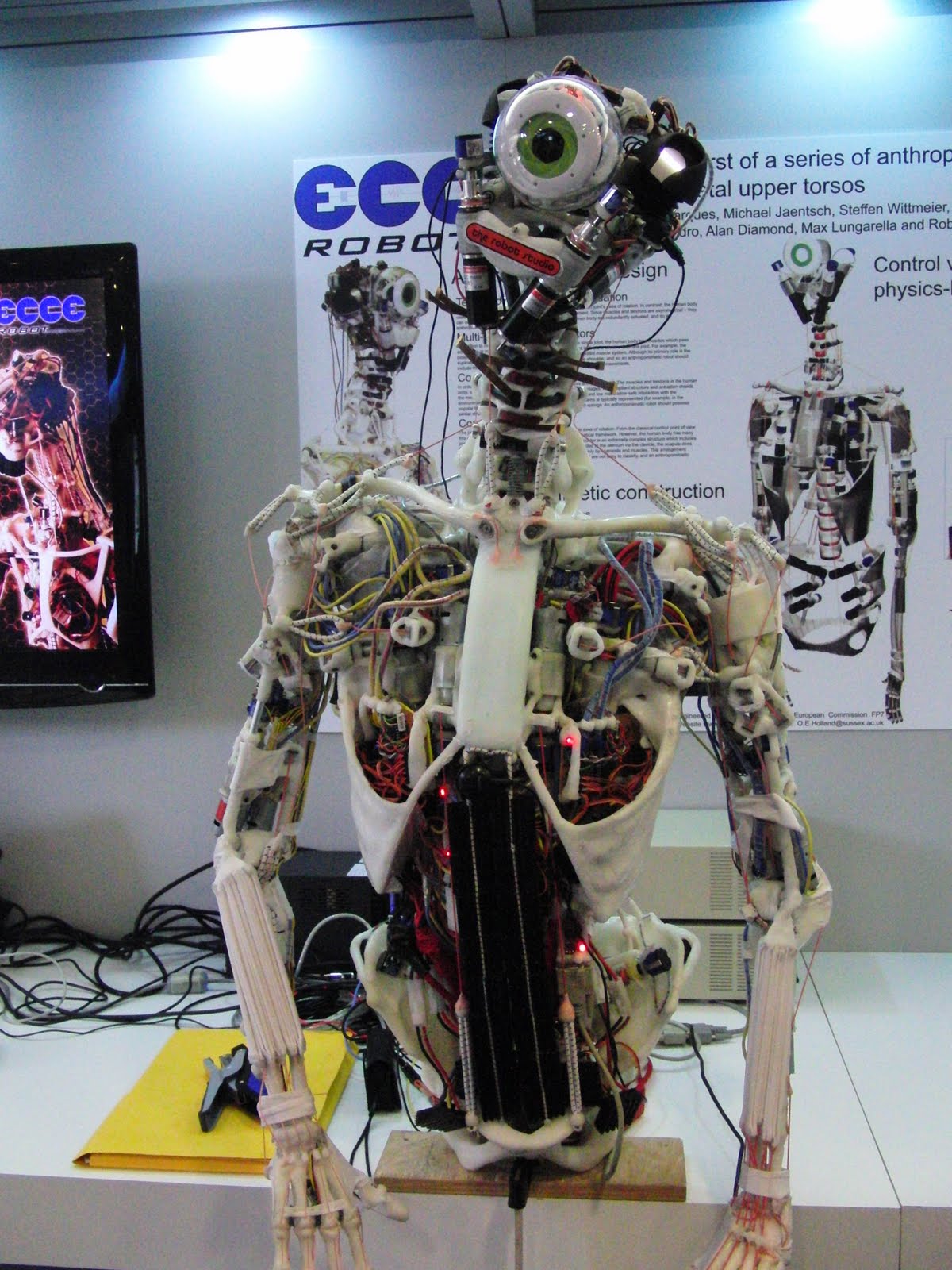
In the beginning you see a cyclops bot, the ECCE1: the first of a series of anthropomimetic musculoskelal upper torsos. That means its torso is designed to look very human-like, together with the noises from the servos it gives me quite a Terminator feeling (compare it to the ending scene of Terminator 1 movie if you don't believe me). This impression is reinforced by the calculations and identification routines that run down the computer screen while the bot is focusing on you to give you a tight handshake-
Our contribution to the conference was Istváns talk on "Complexity on the workbench" in the science cafe. Istvan had 20 x 20 seconds to present his ideas, where he started with the complexity problem, lead over to possible approaches to build complex self-organizing control systems and finally introduced our framework Frevo from our project MESON as a hands-on tool to practically build such systems.
Next station is the artificial eel bot that is moving around in a water bassin. A nice example of bio-inspired engineering. Still I hope that they don't make it a tool like a colonoscope out of it - just too creepy :-)
The cooperating robots had an interesting setup - the composition of ground robots, a flying multicopter and a robot that can lift itself up a rope. In cooperation, the bots could for example find, grab and fetch a particular book from a shelf. This will save me the way to the library in the future :-)
Another bio-inpired research is on octopus limbs. The biological ones are amazing regarding their adaptibility in length and thickness and their strength. Several research group investigate how these mechanisms can be converted to a technology for robot manipulators. In the video, you can see a first prototype.
The elected winner of the exhibition, was "the future of biomimetic machines", featuring iCub, a humanoid robot used as a platform to study perception and learning processes. In the video, you can see the cute robot following and catching a ball. Considering that the winner at FET'09 was a project featuring a Nao robot, one can conclude: "cuteness wins" :-)
Neither cute nor creepy are the robots from the SYMBRION/REPLICATOR project - they are whatever you want them to be. In the video you can see several parts assembling themselves, very impressive, although the docking mechanism still needs a bit of tuning.
These have been a selection out of approximately 30 demonstrations at FET'11. If you are more interested, go an visit FET next time for yourself, see you there :-)

Thursday, April 28, 2011

Humanity is executing an evolutionary algorithm

One interesting aspect of humans is that they very strongly tend to copy the behavior of famous and admired individuals, a behavior that can also be found for our close relatives, the chimpanzees.
Actually, most of our behavior is based on previous experience and 'aping' others. There are actual very few situations where we use a pure deductive approach to solve a task. Wanna kick a curve ball? You can go for the deductive approach, but you will end up in a complicated physical air flow model. Better watch the neighbor’s boy doing it, and copy the movement.
The reason for this is that we live in a complex world, where the deductive approach usually fails because we cannot build accurate models. You want to start a business on the main street of your town? You would most likely fail trying to build an accurate economic model of your customers without taking into account the experience of people who already had a similar business in a comparable situation.
This leads us to two conclusions:
(i) Looking at whole humanity, we can see that they are executing an evolutionary algorithm, where behavior is inherited from successful individuals and modified to test new hypotheses or to adapt to new situations
(ii) Our intellectual abilities are mainly used to estimate effects of some moderate parameter changes - in evolutionary algorithms, this approach is known of modeling an approximation of the fitness landscape to reduce the number of erroneous trials
So, next time you are at a zoo, don't be too proud of your intellectual abilities - the main mechanism that lets humanity survive in a complex world is copying behavior as part of a giant evolutionary algorithm!

Sunday, October 17, 2010

Ig Nobel Prize goes to research on self-organizing slime mold

The behavior of slime mold, a fungus-like organism, has been one of the most famous models of selforganization. Slime mold begin life as amoeba-like cells, each wandering around in random walk behavior. But under certain environmental conditions they suddenly change their behavior and aggregate to a single multi-cellular body; with the help of chemical signals they self-organize into a network of protoplasmic strands. This emergent behavior can solve complex tasks like creating shortest interconnections between food sources in a maze.
Fuligo septica slime mold
(not dog vomit ;-)
from Wikipedia.org/CC license
A research team in Japan discovered that if they placed food piles (oat flakes) around a central slime mold in the same layout as 36 outlying cities around Tokyo, the mold created a network connecting the food sources that looked similar to the existing rail system. By introducing also topographical barriers, the results were even more similar.
Out of this team, Mark Fricker and Dan Bebber recently received the Ig Nobel award in transportation. The Ig Nobel Prizes are given annually for ten achievements that "first make people laugh, and then make them think.". But they are also a show that makes people's interested in science, so the Ig Nobel award might be considered more than just a Nobel Prize parody. However, the slime mold result being awarded there shows that many people still perceive complex systems result as something strange, funny, or improbable. Still, it is great to see research on self-organizing systems awarded!

Tuesday, September 21, 2010

Maxis' forgotten game

Maxis has quite a record in providing interesting simulation games since they came out with SimCity. The game SimLife: The Genetic Playground, however, never became a hit. In the game you can simulate an ecosystem including a climate simulation, a plant groth model and a complex model of animals including herbivores (plant eaters), carnivores (meat eaters), and filter feeders. Not enough, they added an evolution model including genes and phenotypes for all plants and animals.
At this point it becomes clear why this game was without success: it is more a research simulation than an actual game. The number of statistics and graphs also support this impression. Moreover, I guess that the actual processing power at the beginning of the nineties did not allow for extensive simulation experiments. Another distinctive feature between a game and a scientific experiment: a game is designed to give the player a fair chance of success (at least in the lower level). In contrast, SimLife simulations tend to end up in extinct animals and low-diversity flora very often. For example, Spore (from Electronic Arts, which bought Maxis some time ago) has a similar scenario, but is designed as a game. I was not really able to create a stable ecology with more than 5 different species, but still I prefer SimLife over Spore.


In overall, SimLife is interesting from a complex systems point of view even still today. If you want to try it, find it at some abandonware site and run it using an emulator, e.g. dosbox.

Wednesday, August 4, 2010

Sometimes, self-organizing systems fail

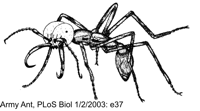
New World army ants are known for their self-organized swarm raids accross the forest searching for food. They form a dense carpet of ants being able to attack much larger animals like larger insects and even lizards. In order to form the swarm, the ants orient themselves by tactual stimulation and by chemical trails laid by other ants. While this system is very effective, it has a potential mode of failure. Sometimes, these ants can get trapped in a circular movement, where the tactual stimulation and the chemical trails will lead to a positive feedback towards moving in a circle. Such behavior has been observed several times in natural environment, it is also relatively easy to reproduce the behavior under lab conditions. In a paper from 1944, T.C. Schneirla elaborates the initial conditions for circling army ants. Under heavy rainfall, these ants tend to move together in a small area. After the rainfall, ants at the margin of the huddle will tend to move around first. They will mostly follow the peripheral of the group due to tactual stimulation and thus create a circular trail of chemicals, which will be followed by the other ants. Army ants have been observed to be circling until they die of dehydration. This example shows that even systems which are evolved and hardened by billions of years of evolution (for organisms in general, ants came into existence about 130 million years ago when they split from the wasps) can be trapped in unwanted behavior.