Showing posts with label robots. Show all posts

Tuesday, August 27, 2024

RoboTunes: A Multi-Player Learning Framework with Musical Programmable Robots

Our paper, "RoboTunes: A Multi-Player Learning Framework with Musical Programmable Robots," presented at ICARA 2024, introduces an innovative educational tool that combines robotics and music to create an interactive learning environment. The RoboTunes framework allows students to control robots using musical instruments, navigating a Colorized Music-based Maze (CMM) by playing specific notes. This approach teaches the basics of robotics and integrates musical learning, making the educational process more engaging and enjoyable.

RoboTunes is designed to be adaptable to different age groups and skill levels. For beginners, tasks may involve simple note sequences to guide a robot, while advanced students can program robots to achieve similar goals, adding layers of complexity. The system supports both collaborative and competitive learning, encouraging teamwork and problem-solving while maintaining a fun, game-like atmosphere.

Colorized Music-based Maze
Example of a Colorized Music-based Maze
The overall goal of RoboTunes is to enhance the educational experience by making learning interactive and enjoyable. By integrating music with robotics, the framework fosters creativity, technical skills, and collaborative abilities, transforming how robotics is taught in classrooms and inspiring students to explore the intersection of these fields further.

Find more information in the fulltext of our paper:

Khalil Al rahman Youssefi, Helmut Lindner, and Wilfried Elmenreich. Robotunes: A multi-player learning framework with musical programmable robots. In Proceedings of the 10th International Conference on Automation, Robotics and Applications (ICARA), pages 334–338, February 2024. (doi:10.1109/ICARA60736.2024.10553175)

Monday, August 7, 2017

The Spiderino Swarm Robot at Research Days 2017

In Klagenfurt from July 10-12, 2017, the Lakeside Research Days were held in collaboration between the Lakeside Labs and the Alpen-Adria-Universität Klagenfurt. Researchers presented their work and discussed open issues in self-organization and swarm intelligence in cyber physical systems.


The Research Days included also laboratory sessions with training on swarm robotics platform. Midhat Jdeed from theAlpen-Adria-Universität gave a lab session about Spiderino, how to program and implement the basic functionalities such as walking, turning and lighting two LEDs using Arduino Studio. In addition, a program has been implemented using sensors distance to make a small swarm of Spiderinos search for the light source and follow it. The sensors employed in Spiderino are CNY70s, which can measure distances and detect obstacles based on the amount of reflected light from an obstacle. This method is prone to ambient light, but it can be also used to make the robots finding a light source.


In the lab session, the Research Days participants learned about the possibilities and programming interface of Spiderino and could implement their own first program hands on. By the end of the session we had a lab of swarming spiders.

More details about Research Days 2017 can be found on the Research Days'17 webpage.

If you want to learn more about the Spiderino swarm robot, check out this paper:

M. Jdeed, S. Zhevzhyk, F. Steinkellner, and W. Elmenreich. Spiderino - a low-cost robot for swarm research and educational purposes In Proceedings of the 13th International Workshop on Intelligent Solutions in Embedded Systems (WISES'17), Hamburg, Germany, June 2017.

Monday, April 6, 2015

Call for Papers Ninth IEEE International Conference on Self-Adaptive and Self-Organizing Systems (SASO 2015)

 The Ninth IEEE International Conference on Self-Adaptive and Self-Organizing Systems (SASO 2015)

Boston Massachusetts; 21-25 September 2015

Part of FAS* - Foundation and Applications of Self* Computing Conferences

Colocated with:

Aims and Scope

http://en.wikipedia.org/wiki/BostonThe aim of the Self-Adaptive and Self-Organizing systems conference series (SASO) is to provide a forum for the foundations of a principled approach to engineering systems, networks and services based on self-adaptation and self-organization. The complexity of current and emerging networks, software and services, especially in dealing with dynamics in the environment and problem domain, has led the software engineering, distributed systems and management communities to look for inspiration in diverse fields (e.g., complex systems, control theory, artificial intelligence, sociology, and biology) to find new ways of designing and managing such computing systems. In this endeavor, self-organization and self-adaptation have emerged as two promising interrelated approaches. They form the basis for many other self-* properties, such as self-configuration, self-healing, or self-optimization. Systems exhibiting such properties are often referred to as self-* systems.

The ninth edition of the SASO conference embraces the inter-disciplinarity and the scientific, empirical, and application dimensions of self-* systems and welcomes novel results on both self-adaptive and self-organizing systems research. The topics of interest include, but are not limited to:

  • Self-* systems theory: theoretical frameworks and models; biologically- and socially-inspired paradigms; inter-operation of self-* mechanisms;
  • Self-* systems engineering: reusable mechanisms, design patterns, architectures, methodologies; software and middleware development frameworks and methods, platforms and toolkits; hardware; self-* materials;
  • Self-* system properties: robustness, resilience and stability; emergence; computational awareness and self-awareness; reflection;
  • Self-* cyber-physical and socio-technical systems: human factors and visualization; self-* social computers; crowdsourcing and collective awareness; human-in-the-loop;
  • Applications and experiences of self-* systems: cyber security, transportation, computational sustainability, big data and creative commons, power systems; swarm systems and robotics.
  • Self-* in education: experience reports; curricula; innovative course concepts; methodological aspects of self-* systems education

Contributions must present novel theoretical or experimental results; novel design patterns, mechanisms, system architectures, frameworks or tools; or practical approaches and experiences in building or deploying real-world systems and applications. Contributions contrasting different approaches for engineering a given family of systems, or demonstrating the applicability of a certain approach for different systems, are equally encouraged. Likewise, papers describing substantial innovation or insights in the use and communication of self-* systems in the classroom are welcome.

Where relevant and appropriate, accepted papers will also be encouraged to participate in the Demo or Poster Sessions.

Important Dates

Abstract submission: May 8, 2015
Paper submission: May 22, 2015 (There will be no extensions of this deadline)
Notification: June 30, 2015
Camera ready copy due: July 17, 2015
Conference: September 21-25, 2015

Submission Instructions

All submissions should be 10 pages and formatted according to the IEEE Computer Society Press proceedings style guide and submitted electronically in PDF format.
Please register as authors and submit your papers using the SASO 2015 conference management system, which is located at:

https://www.easychair.org/conferences/?conf=saso2015

The proceedings will be published by IEEE Computer Society Press, and made available as a part of the IEEE digital library. Note that a separate call for poster submissions has also been issued.
Review Criteria

Papers should present novel ideas in the cross-disciplinary research context described in this call, clearly motivated by problems from current practice or applied research.

We expect both theoretical and empirical contributions to be clearly stated, substantiated by formal analysis, simulation, experimental evaluations, comparative studies, and so on. Appropriate reference must be made to related work. Because SASO is a cross-disciplinary conference, papers must be intelligible and relevant to researchers who are not members of the same specialized sub-field. Authors are also encouraged to submit papers describing applications. Application papers are expected to provide an indication of the real world relevance of the problem that is solved, including a description of the deployment domain, and some form of evaluation of performance, usability, or comparison to alternative approaches. Experience papers are also welcome, but they must clearly state the insight into any aspect of design, implementation or management of self-* systems which is of benefit to practitioners and the SASO community

Conference General Chairs

  • Howard E. Shrobe, MIT CSAIL, Cambridge, MA, USA
  • Julie A. McCann, Imperial College London, UK

Program Chairs


  • Emma Hart, Edinburgh Napier University
  • Gregory Sullivan, BAE Systems AIT
  • Jan-Philipp Steghöfer, University of Gothenburg, Sweden

Sunday, February 1, 2015

Comparison of Metaheuristic Algorithms for Evolving a Neural Controller for an Autonomous Robot

Robots are a good way to test things. Hope our robot overlords of the future will not take this to personal…

The task
We used a simulation of a robot that is searching for a light source as a testbed to compare how well a solution can be created by evolving an artificial neural network (ANN). While ANNs are often programmed using example input-output pairs which are learned by a backpropagation algorithm (supervised learning), in our case we left the how up to the system and only required the what – the robot should be able to find the light source by operating its wheels and using its sensors – that is called learning with belated rewards or reinforcement learning. We compared different evolutionary algorithms (EA), namely simple EA, two dimensional cellular EA, and random search, according to their performance in evolving a successful algorithm for the light-searching robot. In our experiments we studied the effects of EA parameters on performance, such as population size and number of generation. The simulations have been done using the open-source tool Framework for Evolutionary Design (FREVO).

The results explain how the choice of the neural network (three-layered or fully-connected) may inf
Possible implementation in hardware
luence the quality of a final solution. The results indicate that cEA and simple EA are the most applicable for evolving a neural controller. A fully-connected ANN outperforms three-layered ANN in all conducted experiments. Based on our findings, we recommend to use cEA and fully-connected ANN for problems that require short evaluation phase. For a large number of generations and population size the efficiency of both algorithms are approximately the same. In the experiments we measured an influence of population size and number of generations on performance of metaheuristic algorithms. The dependencies on these parameters are negligible. This information is important for the conduction of experiments. To accelerate a simulation, the population size should be the same as the number of cores on the server, where these experiments will be performed.

Tuesday, January 20, 2015

Call for Papers 10th International Conference on Soft Computing Models in Industrial and Environmental Applications (SOCO 2015)


In conjunction with:
CISIS 2015
and
ICEUTE 2015

The 10th International Conference on Soft Computing Models in Industrial and Environmental Applications will take place in Burgos, Spain. Soft computing represents a collection or set of computational techniques in machine learning, computer science and some engineering disciplines, which investigate, simulate, and analyze very complex issues and phenomena. This conference is mainly focus on its industrial and environmental applications.

Topics of interest include, but are not limited to:
• Green Computing
• Evolutionary Computing
• Neuro Computing
• Probabilistic Computing
• Immunological Computing
• Hybrid Methods
• Causal Models
• Case-based Reasoning
• Chaos Theory Fuzzy Computing
• Intelligent Agents and Agent Theory
• Interactive Computational Models

The application fields of interest cover, but are not limited to:
• Decision Support
• Process and System Control
• System Identification and Modelling
• Optimization
• Signal or Image Processing
• Vision or Pattern Recognition
• Condition Monitoring
• Fault Diagnosis
• Systems Integration
• Internet Tools
• Human Machine Interface
• Time Series Prediction
• Robotics
• Motion Control & Power Electronics
• Biomedical Engineering
• Virtual Reality
• Reactive Distributed AI
• Telecommunications
• Consumer Electronics
• Industrial Electronics
• Manufacturing Systems
• Power and Energy
• Data Mining
• Data Visualisation
• Intelligent Information Retrieval
• Bio-inspired Systems
• Autonomous Reasoning
• Intelligent Agents

Important Dates

Paper submission deadline: 24th January, 2015
Acceptance notification: 13th February, 2015
Submission of final papers: 3rd March, 2015
Final version submission: 13th March, 2015
Conference dates: 15th-17th June, 2015

Monday, November 24, 2014

Scalability in Self-Organizing Systems

One of the properties of self-organizing systems is scalability. It means that system keeps its working capabilities even if we remove some of its components or add more of them. In our reseach, we employ different evolutionary algorithms (EAs) to create a self-organizing system. In particular, algorithms like a simple evolutionary algorithm or a two dimensional cellular EA are used  for adjusting the synaptic weights of an neural controller. The best solutions are identified based on simulations of the target application. Typically, the simulation parameters limit the applicability of the solution - there is no guarantee that an evolved solution is adaptable or scalable to situations not specified in the simulation parameters. On the other hand, there are many examples in nature where solutions could be successfully employed in other contexts. We decided to check how our soccer teams, which consist of evolved neural controllers, can scale.

For the FIFA World Cup in Brazil we organized our own tournament between evolved self-organized soccer teams. This is an exciting show - to see how simple agents having only partial information about the environment around them are reaching its goal (score a goal) as a team. Will they be able to play in the same manner if we take the contoller, trained in the simulation with 10 players per team, and increase or decrease the number of players? This question has remained open until today.

In our first scenario, we assume that we invited two soccer teams to show us a fantastic game, but due to some circumstances, only 4 players per teamshow up.
Thus our first experiment can be seen in the video below.
Despite the players being evolved in a context of 11 players on each side, reducing the number of players did not affect the ability of players to show good game.


To check the other extreme, we settled a very dangerous experiment - each team consisting of 40 players! The results were stunning (see video below). These soccer heroes could play as a team even with significantly increased number of players. Unfortunately, they could not play for a long time in this mode: Marco Materazzi headbutted Zinadine Zidane in the chest and shouted "Revenge!"; Luis Suarez bit two players in order to show his perfect teeth; Diego Maradona scored the goal by striking the ball with his hand and this time he was disqualified for this trick. We didn't care about these incidents since we got the results of our experiment:


Links:

Wednesday, June 11, 2014

Simulating the Soccer World Cup 2014

You cannot wait for the soccer World Cup to start? We proudly present a peek preview of the World Cup 2014 - played by teams created with evolutionary algorithms. Using our evolutionary tool FREVO for designing self-organizing systems we have evolved neural networks that make robots playing soccer. During the evolution phase, a fitness function combines different aspects of gameplay like zone defense, man-marking, passing, shots, and goals. By tweaking the weights for these parameters we can influence the playing style of a team while the overall gameplay is still generated automatically by the evolutionary process. Thus we can simulate playing styles of different national teams and then match them against each other.

The following video shows a simulation of Brazil versus Croatia, the opening game of the world cup. The commentary is from Toni Polster, a legendary Austrian soccer player.


While the result is credible, we have not done this to exactly predict the outcome of the games - this would spoil the whole tournament! Furthermore, our approach is not meant for prediction but a system to train a distributed agent-based system to achieve an emergent cooperative behavior in a self-organized way. Setting up this work helped us in improving our understanding how we can create and guide self-organizing systems. We have chosen the soccer simulation as a demonstration because in soccer the global goal (no pun intended) can be achieved in so many different ways , for example with a defensive, offensive, kick-and-rush, pass-intensive, etc. style. And it is nice to watch - who said good science can't be fun!

Further readings:

Tuesday, April 15, 2014

How the body affects the mind - On the effects of robot configuration on evolved behavior

The design of robotic controllers through evolutionary methods requires making a large number of choices about the experimental setup, which are often left to the expertise or naïveté of the experimenter. Although much attention is normally given to the fitness function or the genotype-to-phenotype mapping determining the robot controller, the robot configuration is often selected with little care. Yet, an ill-defined configuration - in terms of the selected subset of the sensory-motor system, or in the pre-processing of the raw sensor data - may be decisive in determining the failure of the evolutionary process.

Different emerged patterns 
simulated with ARGoS
In our paper "On the effects of the robot configuration on evolving coordinated motion behaviors" we studied the effect of different robot configurations on the ability to evolve efficient behaviors for a swarm robotics system. In this domain, the choice of a good configuration is fundamental as even small details can lead to large differences in the group behavior. To demonstrate the importance of the robot configuration, we test different alternatives and measure the group performance on a bi-objective scale.

The results show that different configurations not only have a strong effect on performance, but they also correspond to behaviors with radically different features concerning the organization of the group.

The following video illustrates three basic behaviors that emerged: wavefront, train and flocking:


For more information, see:

I. Fehérvári, V. Trianni, and W. Elmenreich. On the effects of the robot configuration on evolving coordinated motion behaviors. In Proceedings of the IEEE Congress on Evolutionary Computation. IEEE, June 2013.

Thursday, April 12, 2012

Symposium on Self-* Systems – Biological Foundations and Technological Applications

The Symposium on Self-* Systems – Biological Foundations and Technological Applications was part of the European Meeting on Cybernetics and Systems Research (EMCSR 2012) taking place from April 10-13 in Vienna, Austria. It was organized by Vesna Sesum-Cavic, Carlos Gershenson and Wilfried Elmenreich.

Tomonori Hasegawa presented insights on the self-referential logic of self-reproduction originally formulated by John von Neumann and introduced an implementation of this abstract architecture embedded within the Avida world [1]. In the experiments, a sophisticated von Neumann Self-Referential Machine, which was introduced as seeding mechanism, can degrade to a mere copy machine that has dropped the self-referential part. Thus, with this particular implementation, in this particular world, the von Neumann architecture proves to be evolutionarily unstable and degenerates, surprisingly easily, to a primitive, non-self-referential, “copying” or “template replication”, mode of reproduction
Questions arose if a von Neumann Self-Referential Machine could evolve from a simple self-copy machine in a different set-up. The von Neumann model has the advantage of enabling new and more ways to change the system upon mutation - but what could be the evolutionary pressure to have a von Neumann architecture evolved in the first place?
Current experiments did not include sexual reproduction - could that facilitate the evolution of more complex architectures?
More from the group can be found at http://evosym.rince.ie/

Modern software systems suffer from increased complexity. Large software systems are composed of many components that are interlinked. The internal states of these systems contain a huge amount of information. The main obstacles lie in the lack of the reliability and robustness which lead to poor performance. For complex intractable problems, a random search (Monte-Carlo method) does not perform well. New and advanced approaches are necessary to deal with complexity.
Milan Tuba proposed a guided Monte-Carlo search method based on a hybrid of reinforcement learning and a genetic algorithm[2]. As a proof-of-concept the approach is applied to the problem of information retrieval in the internet.
In the discussion, the performance of the algorithm in comparison to commercial search providers, like Google, was discussed.

Sander van Splunter presented ideas on the coordination and self-organization in crisis management[3]. The main idea is to move from a task-oriented top down approach towards an emergence-oriented bottom-up approach, while keeping, a hierarchical structure. However, higher level entities control lower levels by policy, not directly. Policy defines interaction, prioritization and coordination of entities.
An entity works as an independent agent following the given policies. An important feature could be the ability to predict the failure in a given subsystem.
According to EMCSR'12 keynote lecture of Peter Csermely we have to watch signs like slower recovery, increased self-similarity, and increased variance of fluctuation patterns in order to predict a system change into a state where it cannot handle the its environment with its current policies.
In the proposed crisis management of van Splunter and van Veelen a subsystem is supposed to emerge a warning when local adaption fails to handle the problem, e.g. if a small team of firefighters cannot confine a fire in their assigned area.

Carlos Gershenson told us about "Living in living cities"[4]. One of the challenges of 21st century is preventing the problems in the ultra-fast growing cities all over the world.
These are non-stationary (changing problems), traditional algorithms do not work well. Such challenges are for example urban mobility, logistics, telecommunications, governance, safety, sustainability, society and culture. A solution is to exploit properties of living systems, which are adaptive, learning, evolving, robust, autonomous, self-repairing, and self-reproducing, and to understand cities metaphorically as organisms.
Engineering methods cannot find a single solution to these changing problems. Instead it is necessary to constantly adapt the solution, thus have a self-organizing solution to a complex problem. Will cities become the "killer app" of cybernetics and systems research?
Discussion arose around the following issues:
But how do you get the officers and responsibles of a city to cooperate? There is a need for a strong motivation to overcome the inertia of the system.
Could cities instead built from scratch? No, because of the legacy issues - it is not possible to just tear down a large city and build it anew every few decades.
Can we prove that the system is robust against malicious behavior? Difficult since such a complex system cannot be easily predicted for all sets of possible inputs.
Are explicit measures necessary or would people themselves care for the necessary adaptations? This would not increase living standard for the people.

Anita Sobe presented ideas on self-organizing content sharing at social events by such interesting examples as the marriage of Kate and William of Windsor or Barack Obama's inauguration[5].
The presented approach allows people to share their self-generated content like photos or short videos instantly at such events. Existing platforms like flickr or youtube do not provide this liveness since most content is uploaded with a few days delay. The proposed approach organizes the content using an artificial hormone system. The hormone distribution is sensitive to the quality of a network connection and therefore, reflects a quality-of-service for a network path. The system is solely based on local decisions for forwarding, replicating and moving content. Over time, the content distribution in the network gets optimized in order to support short response times for requesters. Simulations show that the system competes well to other epidemic information dissemination methods such as Gossip.
The follow-up discussion brought up interesting questions:
How is overhead reflected in the simulation? Currently overhead is implicitly modeled into the transmission cost, which is valid for a constant packet handling overhead.
Furthermore the relation of the hormone-based approach to an ant colony optimization (ACO) algorithm was discussed. We identified a major difference to ACO, since there typically either the network or the content is assumed to be static. However ACO could be extended to handle the described scenario, which might inspire future work.
What is the effect, if tags are (more) complex? The system was started with a predefined tag hierarchy which can be extended to a more complex tag hierarchy. However, with more complex tags there is no guarantee for finding content.

In the last talk, Wilfried Elmenreich gave a talk on evolving a distributed control algorithm for flying UAV drones for a coverage problem[6]. The problem of having multiple mobile agents covering (or as we say in robotics, "sweeping") an area is relevant for many applications like lawn mowing, snow removal, floor cleaning,  environmental monitoring, communication assistance and several military and security applications.
The work by Istvan Fehervari, Wilfried Elmenreich and Evsen Yanmaz described a simple grid-based abstraction of the problem which was used to test two evolved and one handcrafted control algorithm which were compared to  reference algorithms like random walk and random direction.
A short summary of Wilfried's talk and the slides are available here.
The talk triggered interesting discussion involving the comparison with the “belief-based” algorithm. A further question triggering future work is on the influence on the layout and number of sensors. What will happen if the environment changes? Since the algorithm has no memory of a map, a changing environment does not affect the result.

References
  1. B. McMullin, T. Hasegawa. Von Neumann Redux: Revisiting the Self-referential Logic of Machine Reproduction Using the Avida World. In R. M. Bichler, S. Blachfellner, and W. Hofkirchner, editors, European Meeting on Cybernetics and Systems Research Book of Abstracts, Vienna, Austria, April 2012.
  2. V. Sesum-Cavic, M. Tuba, and S. Rankow. The Influence of Self-Organization on Reducing Complexity in Information Retrieval. In R. M. Bichler, S. Blachfellner, and W. Hofkirchner, editors, European Meeting on Cybernetics and Systems Research Book of Abstracts, Vienna, Austria, April 2012.
  3. S. van Splunter, B. van Veelen. Coordination and Self-Organisation in Crisis Management. In R. M. Bichler, S. Blachfellner, and W. Hofkirchner, editors, European Meeting on Cybernetics and Systems Research Book of Abstracts, Vienna, Austria, April 2012.
  4. C. Gershenson. Living in Living Cities. In R. M. Bichler, S. Blachfellner, and W. Hofkirchner, editors, European Meeting on Cybernetics and Systems Research Book of Abstracts, Vienna, Austria, April 2012.
  5. A. Sobe, W. Elmenreich, and M. del Fabro. Self-organizing content sharing at social events. In R. M. Bichler, S. Blachfellner, and W. Hofkirchner, editors, European Meeting on Cybernetics and Systems Research Book of Abstracts, Vienna, Austria, April 2012.
  6. I. Fehérvári, W. Elmenreich, and E. Yanmaz. Evolving a team of self-organizing UAVs to address spatial coverage problems. In R. M. Bichler, S. Blachfellner, and W. Hofkirchner, editors, European Meeting on Cybernetics and Systems Research Book of Abstracts, Vienna, Austria, April 2012.

Thursday, August 11, 2011

Science beyond Fiction - A visit at FET 2011

The European Future Technologies Conference FET is a bi-annual cross-disciplinary conference for frontier research in Europe.
I visited the conference for the second time (last time in 2009 in Prague). This year in Budapest, topics covered robotics, complexity, evolutionary computation and brain research. But, the most entertaining part of this conference are always the exhibitions.
The video gives a short 2-minutes tour through the stations that impressed me the most:


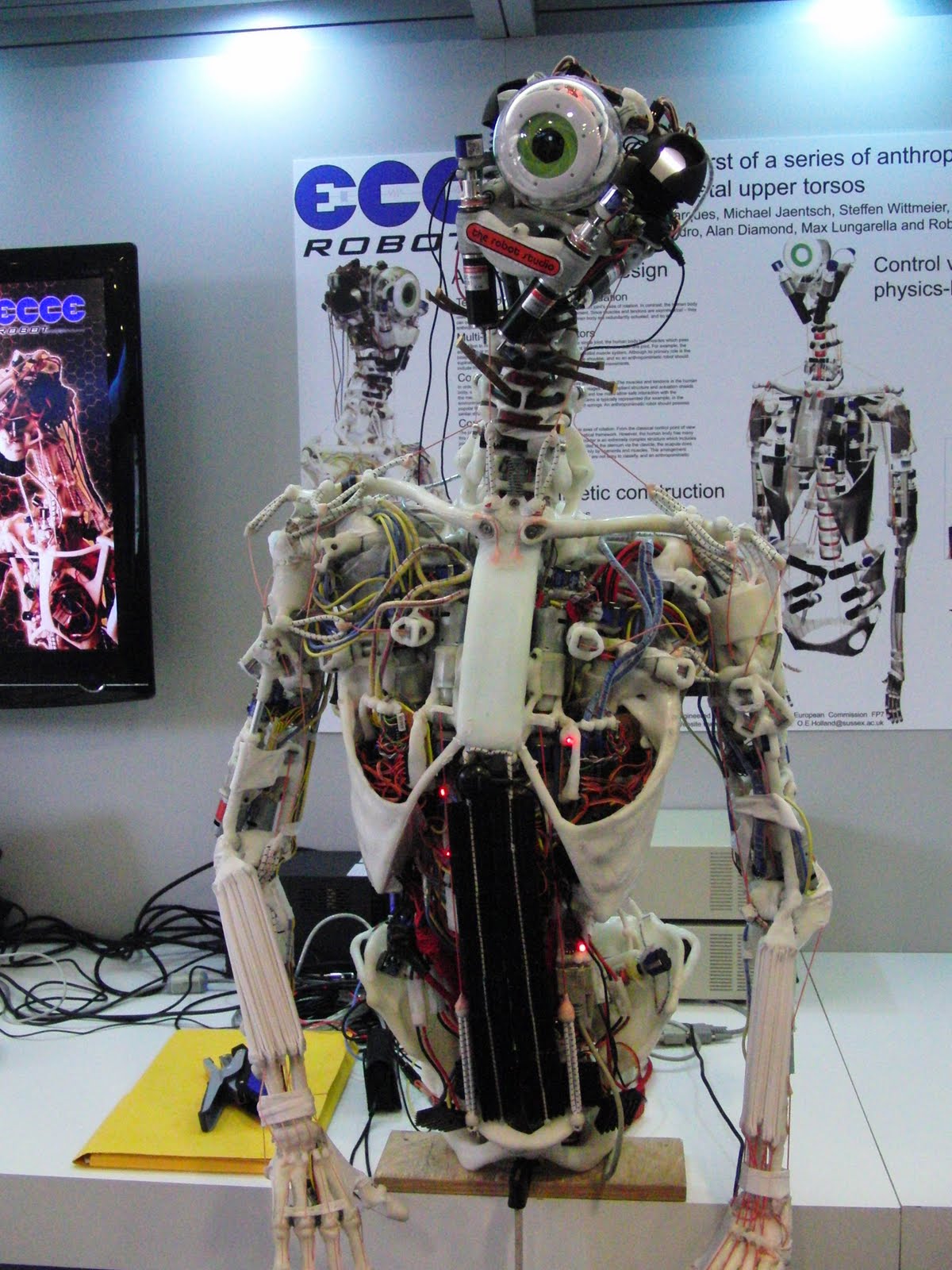
In the beginning you see a cyclops bot, the ECCE1: the first of a series of anthropomimetic musculoskelal upper torsos. That means its torso is designed to look very human-like, together with the noises from the servos it gives me quite a Terminator feeling (compare it to the ending scene of Terminator 1 movie if you don't believe me). This impression is reinforced by the calculations and identification routines that run down the computer screen while the bot is focusing on you to give you a tight handshake-
Our contribution to the conference was Istváns talk on "Complexity on the workbench" in the science cafe. Istvan had 20 x 20 seconds to present his ideas, where he started with the complexity problem, lead over to possible approaches to build complex self-organizing control systems and finally introduced our framework Frevo from our project MESON as a hands-on tool to practically build such systems.
Next station is the artificial eel bot that is moving around in a water bassin. A nice example of bio-inspired engineering. Still I hope that they don't make it a tool like a colonoscope out of it - just too creepy :-)
The cooperating robots had an interesting setup - the composition of ground robots, a flying multicopter and a robot that can lift itself up a rope. In cooperation, the bots could for example find, grab and fetch a particular book from a shelf. This will save me the way to the library in the future :-)
Another bio-inpired research is on octopus limbs. The biological ones are amazing regarding their adaptibility in length and thickness and their strength. Several research group investigate how these mechanisms can be converted to a technology for robot manipulators. In the video, you can see a first prototype.
The elected winner of the exhibition, was "the future of biomimetic machines", featuring iCub, a humanoid robot used as a platform to study perception and learning processes. In the video, you can see the cute robot following and catching a ball. Considering that the winner at FET'09 was a project featuring a Nao robot, one can conclude: "cuteness wins" :-)
Neither cute nor creepy are the robots from the SYMBRION/REPLICATOR project - they are whatever you want them to be. In the video you can see several parts assembling themselves, very impressive, although the docking mechanism still needs a bit of tuning.
These have been a selection out of approximately 30 demonstrations at FET'11. If you are more interested, go an visit FET next time for yourself, see you there :-)

Thursday, June 16, 2011

Open PhD Position in Complex Systems

It could be you!
We are looking for a PhD student to do research in the MESON (Modelling and Engineering of Self-Organizing Networks) project. We are a highly motivated international team of researchers situated at the Lakeside Science & Technology Park/University of Klagenfurt, Austria. We offer best work conditions, a beautiful campus with a pleasant, intercultural work environment, and a highly competitive salary.
Potential candidates should have a master's degree in computer science, computer engineering, mathematics, physics or related studies and should have skills in creative problem solving, Java programming, the use of the English language and knowledge in at least one of the following subjects:
  • Complex systems, or
  • Machine Learning, or
  • Multi-agent systems, or
  • Robotics
Research will be conducted at the Institute of Networked and Embedded Systems under the supervision of Wilfried Elmenreich. Working language is English. The institute cooperates with national and international partners from industry and academia and is part of the research cluster Lakeside Labs. Further information about the MESON project can be found on the project webpage. Women are especially encouraged to apply. Please mail applications containing a letter of interest, curriculum vitae, copies of academic certificates and courses, list of publications, and contact details of two references in a single PDF file to applications@lakeside-labs.com by deadline of Juli 31st, 2011.

Friday, April 1, 2011

iBraitenberg

Braitenberg robot approaching a light source
A Braitenberg vehicle is a simple robot that is able to show interesting complex behavior. The main feature of a Braitenberg vehicle is that it lacks a complex controller but instead directly connects the sensors' output to some actuators' input. That way, a two-wheeled vehicle can, e.g. be told to approach or to flee from an object detected by the sensors. Dominik Egarter has build a nice Braitenberg vehicle using Lego mindstorms. To be exact, it is a Braitenberg emulator contained in the Lego Mindtstorms controller brick. The interesting feature is that the vehicle can be configured via a nice iPhone app. The iBraitenberg app is a useful demonstrator to introduce robotics to pupils. We presented the work at an open lab day at the university, where the project attracted a lot of people, among them several kids.


Movie explaining the vehicle and demonstrating the iBraitenberg app.