Showing posts with label event. Show all posts

Monday, August 7, 2017

The Spiderino Swarm Robot at Research Days 2017

In Klagenfurt from July 10-12, 2017, the Lakeside Research Days were held in collaboration between the Lakeside Labs and the Alpen-Adria-Universität Klagenfurt. Researchers presented their work and discussed open issues in self-organization and swarm intelligence in cyber physical systems.


The Research Days included also laboratory sessions with training on swarm robotics platform. Midhat Jdeed from theAlpen-Adria-Universität gave a lab session about Spiderino, how to program and implement the basic functionalities such as walking, turning and lighting two LEDs using Arduino Studio. In addition, a program has been implemented using sensors distance to make a small swarm of Spiderinos search for the light source and follow it. The sensors employed in Spiderino are CNY70s, which can measure distances and detect obstacles based on the amount of reflected light from an obstacle. This method is prone to ambient light, but it can be also used to make the robots finding a light source.


In the lab session, the Research Days participants learned about the possibilities and programming interface of Spiderino and could implement their own first program hands on. By the end of the session we had a lab of swarming spiders.

More details about Research Days 2017 can be found on the Research Days'17 webpage.

If you want to learn more about the Spiderino swarm robot, check out this paper:

M. Jdeed, S. Zhevzhyk, F. Steinkellner, and W. Elmenreich. Spiderino - a low-cost robot for swarm research and educational purposes In Proceedings of the 13th International Workshop on Intelligent Solutions in Embedded Systems (WISES'17), Hamburg, Germany, June 2017.

Wednesday, May 3, 2017

Research Days on Self-Organization and Swarm Intelligence in Cyber Physical Systems

July 10 – 12, 2017
Lakeside Labs
Klagenfurt, Austria

Systems with swarm intelligence consist of a set of agents, with local intelligence, interacting locally. Typically, approaches for swarm intelligence come from biological systems, like ant or bee colony behavior, schooling of fishes, flocking of birds, etc. As the agents follow very simple rules without a central control dictating their activities, the interactions between those agents lead to the emergence of intelligent or complex global behavior. In other words, CPS researchers need to learn how to construct and apply techniques for self- organization and swarm intelligence, their opportunities and challenges.

At the Research Days 2017, a group of international researchers will discuss how this translation between CPS, self-organization, and swarm intelligence can be achieved on a theoretical and practical basis. The Research Days are a regular event concentrating on the core competence of Lakeside Labs - Self-organizing Networked Systems. During this workshop organized by Lakeside Labs GmbH in cooperation with the University of Klagenfurt, international experts devote themselves to a special topic in self-organization. The event is organized as a workshop of several consecutive days in July. It takes place at Lakeside Labs in Klagenfurt am Wörthersee, Austria, near a beautiful lake and Alps scenery. Invited experts, local professors, and young researchers discuss and elaborate ideas in the field of Self-Organizing Systems (SOS). The main emphasis of the workshop is on soliciting discussions and creating new ideas regarding a topic related to self-organizing systems. The event greatly supports scientific exchange, networking, establishment of international collaborations, and joint research projects.

The following video gives a nice impression of the Research Days:
Learn more and registerfor the event at https://researchdays.lakeside-labs.com/

Tuesday, December 13, 2016

TeWi Hackathon 2016

The technical faculty of the Alpen-Adria-Universität Klagenfurt ist organizing a research demo from 21. to 22. of December 2016. The goal of the hackathon is to (i) find a team with which you can (ii) define a research demo application which you can publish at a scientific conference, and then (iii) implement it in two days time. It’s actually big fun and it gives you the opportunity to learn to knew new people, learn new things ... and publish a new paper.

All kind of folks, including PhD students, post docs, researchers, teachers, professors are invited to join!

Learn more about it on the TeWi Hackathon page.

Friday, December 2, 2016

Advent Programming Contest 2016

An Advent calendar is a special calendar used to count or celebrate the days in anticipation of Christmas. Advent calendars typically begin on December 1 and provide a window to open until December 24. Usually they have windows, which you can open each day containing some chocolate or other stuff. But what is better to kill some time until Christmas, Hanukkah, Yule, Kwanzaa, Diwali, Boxing Day, etc. than an Advent calendar giving you a programming problem every day?

The Advent Programming Contest, being organized by the IEEE Student Branch Klagenfurt will provide a new problem every day from December 1st to December 24th. You can submit solutions any day until the contest ends on December 26. You can choose to use C, C++, C#, Java, Perl, Python 2.x or Python 3.x as programming language. The programming tasks can be solved with short programs (typically less than 100 lines of code). Until a solution is correct you can submit your program as often as you want (but please don't spam our server). The number of tries will not be a criterion for determining your score. The idea is to do it just for fun, but we will try to announce a winner after the contest is closed. The event is open to everyone. There are separate categories for pupils, university students and others. If you want to participate, please register at http://mooshak.nes.aau.at/ (Registration is also possible after 1st December)

Here are some example problems from last year:

 All problems from Adventcoder 2015 can be found in this document. If you want to see the new ones, you need to join the contest :-)

Monday, November 30, 2015

Advent Programming Contest 2015

An Advent calendar is a special calendar used to count or celebrate the days in anticipation of Christmas. Advent calendars typically begin on December 1 and provide a window to open until December 24. Usually they have windows, which you can open each day containing some chocolate or other stuff. But what is better to kill some time until Christmas, Hanukkah, Yule, Kwanzaa, Diwali, Boxing Day, etc. than an Advent calendar giving you a programming problem every day?

The Advent Programming Contest, being organized by the IEEE Student Branch Klagenfurt will provide a new problem every day from December 1st to December 24th. You can submit solutions any day until the contest ends on December 26. You can choose to use C, C++, C#, Java, Perl, Python 2.x or Python 3.x as programming language. The programming tasks can be solved with short programs (typically less than 100 lines of code). Until a solution is correct you can submit your program as often as you want (but please don't spam our server). The number of tries will not be a criterion for determining your score. The idea is to do it just for fun, but we will try to announce a winner after the contest is closed. The event is open to everyone. There are separate categories for pupils, university students and others. If you want to participate, please register at http://mooshak.nes.aau.at/ (Registration is also possible after 1st December)

Wednesday, February 18, 2015

Advent Programming Contest 2014 Awarding

At the awarding ceremony
In December 2014, the Advent Programming Contest (APC) was held for the third time. The joint event between the Faculty of Technical Sciences and the IEEE Student Branch Klagenfurt enjoys increasing popularity every year. This time there were 345 enthusiastic participants who accepted the challenge and tryed to solve a daily programming task from December 1st to December 24th. I hope everybody who participated enjoyed the problems, even though nobody was able to solve all the tasks. While every problem was solved at least once, the maximum number of solved tasks by any participant was 23 out of 24 – given the hardness of several of the problems this is an excellent result.
The winners of the three categories of "student", "university staff" and "other" were announced at a formal ceremony organized by the IEEE Student Branch Klagenfurt. The best student adventcoder was Philip Gasteiger, student of computer science at Alpen-Adria-Universität Klagenfurt.
The best pupil adventcoder, Simon Dörrer, came from HTL Mössingerstraße Klagenfurt. Ben Wright, a recent graduate of the University of Tennessee, Martin, now working as a software engineer won the third category “other” and attended the ceremony via webcast.

Monday, December 1, 2014

Advent Programming Contest 2014

Still in the flow from the IEEEXtreme programming challenge? Looking for a daily new programming problems to train your skills?
The Advent Programming Contest 2014, organized by the IEEE Student Branch Klagenfurt will provide a new problem every day from December 1st to December 24th. On Saturdays and Sundays, new problems will appear at 12:00 Central European Time, on workdays at 18:00 CET. You can submit solutions any day until the contest ends on December 26. You can choose to use C, C++, Java, Python or Perl as programming language. The programming tasks can be solved with short programs (typically less than 100 lines of code). Until a solution is correct you can submit your program as often as you want (but please don't spam our server). Your score depends on the number of correct solutions and the time and trials you needed to solve the problem. Winners will be announced after closing of the contest.

The event is open to everyone. If you want to participate, please register at http://mooshak.nes.aau.at/ When you register please indicate if you belong to the group University, Pupils or other.
This is an individuals competition, not a team contest - be fair!
You can also join the contest after 1st December, registration is possible until December 24.

Saturday, November 30, 2013

Advent Programming Contest 2013

An Advent calendar is a special calendar used to count or celebrate the days in anticipation of Christmas. Advent calendars typically begin on December 1 and provide a window to open until December 24. Usually they have windows, which you can open each day containing some chocolate or other stuff. But what is better to kill some time until Christmas, Hanukkah, Yule, Kwanzaa, Diwali, Boxing Day, etc. than an Advent calendar giving you a programming problem every day?

The Advent Programming Contest 2013, organized by the IEEE Student Branch Klagenfurt will provide a new problem every day from December 1st to December 24th. On Saturdays and Sundays, new problems will appear at 12:00 Central European Time, on workdays at 18:00 CET. You can submit solutions any day until the contest ends on December 26. You can choose to use C, C++, Java, Python or Perl as programming language. The programming tasks can be solved with short programs (typically less than 100 lines of code). Until a solution is correct you can submit your program as often as you want (but please don't spam our server). Your score depends on the number of correct solutions and the time and trials you needed to solve the problem. Winners will be announced after closing of the contest.

The event is open to everyone. If you want to participate, please register at http://mooshak.nes.aau.at/ When you register please indicate if you bleong to the group University, Pupils or other.
This is an individuals competition, not a team contest - be fair!
You can also join the contest after 1st December, Registration will be still possible until December 24.

See also the results form last years Advent Programming contest.

Wednesday, February 27, 2013

Call for Posters 7th International Workshop on Self-organizing Systems IWSOS 2013

IWSOS 2013
7th International Workshop on Self-organizing Systems 
Palma de Mallorca, Spain
May 9-10, 2013

Technical co-sponsors: IFIP TC6 WG6.2, EC FP7 NoE EINS

Poster Abstract Submission Deadline: March 15, 2013

We are looking for submissions of research posters, from both academia and industry, describing research, exciting new research projects, and encouraging preliminary results on self-organizing systems.

** Poster Abstract Submission
The submission should be an extended abstract of two pages in two-column format. All submitted abstracts will undergo a peer review process. Accepted posters must be presented at the conference and will be published electronically in a book (ISBN-indexed) named "Emerging Ideas on Self-Organizing Systems".

Poster abstracts should use the following format: http://ifisc.uib-csic.es/iwsos2013/media/poster_latex_template.zip

Poster abstracts can be submitted via: https://www.edas.info/newPaper.php?c=13239&track=31695

** Important Dates
Submission deadline: March 31, 2013 extended!
Notification:        March 31, 2013
Camera-ready:        April 15, 2013

** Scope
The main themes of IWSOS 2013 are from the fields of techno-social systems and networks-of-networks with their unique and complex blend of cognitive, social, and technological aspects. We will analyse how these systems self-organize, acquire their structure, and evolve. Thus, we aim to advance our understanding of such key infrastructures in our societies and, more generally, of these sorts of self-organizational processes in nature. We are further interested in learning how to engineer such self-organizing networked systems to have desirable properties including dependability, predictability, and resilience in the face of the inevitable challenges that they face. Building on the success of its predecessors, this multi-disciplinary workshop aims at bringing together leading international researchers from complex systems, distributed systems, and communication networks to create a visionary forum for discussing the future of self-organization in networked systems. We invite the submission of manuscripts that present original research results on the themes of self-organization in techno-social systems and networks-of-networks.

** Key Topics
The workshop scope includes, but is not limited to, the following topical areas of self-organizing systems:
- Design and analysis of self-organizing and self-managing systems
- Inspiring models of self-organization in nature and society
- Structure, characteristics, and dynamics of self-organizing networks
- Self-organization in techno-social systems
- Self-organized social computation
- Self-organized communication systems
- Citizen Science
- Techniques and tools for modeling self-organizing systems
- Tools to quantify self-organization
- Control and control parameters of self-organizing systems
- Phase transitions in self-organizing systems
- Robustness and adaptation in self-organizing systems
- Self-organization in complex networks such as peer-to-peer, sensor,
  ad-hoc, vehicular, and social networks
- Self-organization in socio-economic systems
- User and operator-related aspects of man-made self-organizing systems
- Self-organizing multi-service networks and multi-network services
- Methods for configuration and management of large, complex networks
- Self-protection, self-configuration, diagnosis, and healing
- Self-organizing group and pattern formation
- Self-organizing mechanisms for task allocation, coordination and
  resource allocation
- Self-organizing information dissemination and content search
- Security and safety in self-organizing networked systems
- Risks and limits of self-organization
- The human in the loop of self-organizing networks
- Social, cognitive, and semantic aspects of self-organization
- Evolutionary principles of the (future, emerging) Internet
- Decentralized power management in the smart grid

Thursday, February 21, 2013

Call for Papers 6th Complex Systems Modelling and Simulation Workshop (CoSMoS 2013)

Università degli Studi di Milano-Bicocca, Italy
1 day workshop held between 1 - 5 July 2013

http://www.cs.york.ac.uk/nature/cosmos/cosmos2013.html
cosmos2013-group@york.ac.uk

SPECIAL ISSUE OF NATURAL COMPUTING JOURNAL: we will be organising a special issue of the Natural Computing journal (http://www.springer.com/computer/theoretical+computer+science/journal/11047) based on the themes raised in the workshop. Suitable workshop submissions will be invited to submit to this special journal issue.

The 6th workshop on Complex Systems Modelling and Simulation (CoSMoS 2013) will take place as a 1-day satellite workshop of the Unconventional Computation and Natural Computation conference (http://ucnc2013.disco.unimib.it/) held between 1st and 5th July at the Università degli Studi di Milano-Bicocca, Italy. The CoSMoS workshops series provides a forum for research examining all aspects of the modelling and simulation of complex systems. This year, we will place a special focus on how complex systems simulations can be used to simulate unconventional and natural computation.

Constructing models and simulations of complex systems is a challenging and interdisciplinary task. Elements might include choice of modelling tools and techniques, simulation infrastructures, concurrency, the process of moving from models to simulations, arguing validity of simulations, and the identification of reusable engineering techniques such as patterns. The CoSMoS workshop series continues an initiative, based at the Universities of York and Kent, UK, to develop a framework and infrastructure for the construction of complex systems simulations.

Submitted papers will undergo a rigorous peer-review process and accepted papers will appear in the workshop proceedings published by Luniver Press. Proceedings of the previous CoSMoS workshop are available: http://www-users.cs.york.ac.uk/psa/cosmos2013/proceedings.html


AREAS OF INTEREST

We are seeking submissions that explore aspects of complex systems modelling and simulation, with a special focus on how complex systems simulations can be used to simulate unconventional and natural computation. Areas of interest include, but are not limited to:

* Complex systems simulation case-studies
* Modelling tools and techniques
* Simulation infrastructures
* Arguing validity of simulations
* Concurrency and distribution techniques
* Identification of reusable engineering techniques
* Working across scientific disciplines


SUBMISSIONS

We are accepting both full papers (to be presented orally) and abstracts (to be presented via a poster). Both full papers and abstracts will appear in the workshop proceedings.

For submission via abstract, please submit an abstract not longer than 2 pages of LNCS format that summarises the content of the poster you wish to present. Full papers can be of any length up to a maximum of 25 pages of LNCS format. If you wish to exceed the page limit, or have any other queries, then please email cosmos2013-group@york.ac.uk in advance of submission.

LNCS formatting details can be found here: http://www.springer.com/computer/lncs?SGWID=0-164-7-72376-0

Papers should be submitted via EasyChair here: https://www.easychair.org/conferences/?conf=cosmos2013


IMPORTANT DATES

* Paper Submission: 22 March 2013
* Notification of acceptance: 22 April 2013
* Camera ready copies: 6 May 2013
* CoSMoS Workshop: 1 day between 1 - 5 July 2013


WORKSHOP CHAIRS

* Paul Andrews, Department of Computer Science and York Centre for Complex Systems Analysis, University of York, UK
* Susan Stepney, Department of Computer Science and York Centre for Complex Systems Analysis, University of York, UK

Monday, January 14, 2013

Results of Advent Programming Contest 2012

Results are now official! Congratulations to all participants!
Rankings are based on the number of solved problems by a participant. If two or more participants have the same number of solutions, they get the same rank but are listed with the fastest one first. The list contains only participants with at least one correct submission.
 
Rank
Name  Solutions Time Category
1
Alex  24 6986:55:01 school
2
0xbb  22 5734:25:04 university
2
RageQuit  22 5797:02:04 university
2
MichaelLeitgeb  22 6174:29:09 other
5
veilchen2k  21 5616:59:19 university
5
Thomas Dittrich  21 5695:26:07 university
5
dbaeck  21 9437:08:41 university
8
Fastenbauer  19 5332:22:06 other
9
GutBlender  18 7727:53:43 university
10
jenna  16 5967:29:43 other
11
st  15 2607:41:31 university
11
sealfin  15 4320:39:58 other
13
GunnarFarneback  14 2680:56:20 other
13
Eomund  14 2836:04:09 other
15
stefan  13 3028:42:50 school

The winner was awarded an Amazon gift card of 100 €, 50 € for category winners and best female programmer. The full ranking for all active participants is available at ieee.aau.at.

Monday, November 26, 2012

Advent Programming Contest

Welcome, Advent Programmers!
An Advent calendar is a special calendar used to count or celebrate the days in anticipation of Christmas. Advent calendars typically begin on December 1 and provide a window to open until December 24. Usually they have windows, which you can open each day containing some chocolate or other stuff. But what is better to kill some time until Christmas, Hanukkah, Yule, Kwanzaa, Diwali, Boxing Day, etc. than an Advent calendar giving you a programming problem every day?

The Advent Programming Contest, being organized by the newly formed IEEE Student Branch Klagenfurt will provide a new problem every day from December 1st to December 24th. You can submit solutions any day until the contest ends on December 26. You can choose to use C, C++, Java, Python or Perl as programming language. The programming tasks can be solved with short programs (typically less than 100 lines of code). Until a solution is correct you can submit your program as often as you want (but please don't spam our server). The number of tries will not be a criterion for determining your score. The idea is to do it just for fun, but we will try to announce a winner after the contest is closed.

The event is open to everyone as long as our server can handle the load. There are separate categories for pupils, university students and others.

If you want to participate, please register at http://mooshak.nes.aau.at/
This is an individuals competition, not a team contest - be fair!
(Registration will be still possible after 1st December)

See also: Sixth IEEE Xtreme Programming Contest: Bunnies in the Forest

Monday, October 22, 2012

Sixth IEEE Xtreme Programming Contest: Bunnies in the Forest

At the annual IEEE Xtreme Programming Contest teams of three programmers are given a set approximately 20 problems, for which they have to write a program that solves the task. Choice of programming language is mostly free; the contest system supports Java, C, C++, C#, PHP, Python, Ruby. The contest goes on for exactly 24 hours, therefore the "Xtreme" in its name. In the 2012 issue, there had been 1900 teams worldwide. To be successful, it is necessary to work concentrated under pressure for hours and have excellent programming skills. In fact it is rather software engineering skills, since a sloppy or ad-hoc programming style does not lead to successful solutions. Watching a good team one can observe the classic stages of software engineering like specification of operational and performance qualification, design specification, implementation, black box/white box testing, and validation in a fast-forward manner within a few hours.


One important aspect of software engineering is also the proper specification of the intended project by the customer. A mistake in the initial specification is crucial, so it is important to state a task in a clear unambiguous manner. In practice, unfortunately, a software engineering team often has to guess what the customer really wants. This was the case for problem AA at IEEE Xtreme 2012:

In a forest, there were 'x' bunnies, 50% male, and 50% female, all adults. Bunnies doubles every 15 days, 10% of the baby rabbits dies at birth. They mature after 30 days, 30% leave the forest, and rest becomes rabbits. In every 30 days , 25% dies off due to flu. If every bunny dies off, the bunny world ends. Calculate the final number of bunnies alive after 1 year for any number of initial bunnies, x.

The problem is very interesting since it defines a simulation of an ecologic system. See for comparison the description of the Lotka Volterra system featuring rabbits and foxes. However, the problem specification is unclear in many aspects. What is the essential difference between an "adult bunny", a bunny, a "baby bunny" and a rabbit? It is not mentioned how to handle rounding, if the leaving of the forest happens once for a group that just matured or if an adult rabbit is tempted to leave the forest every time.

The problem had been complemented by these two test cases:
Test Case 1
444 (input)
0 (output)
Test Case 2
30000 (input)
56854 (output)
So a group of 444 dies out after one year, while a group of 30000 almost doubles. Given that the described effects are all linearly superimposable (except for possible rounding errors), it seems odd how the two groups yield so different results. 30000 is around 68 times as much as 444, so the results just also differ by that factor. The following python program implements one possible interpretation of this problem:
b0=0            #newborn bunnies  
b15=0           #15 day old bunnies 
b30=input()     #30 day old, read from stdin
for i in range(25): #one year
    print "t:",(i*15)," bunnies:",(b0+b15+b30)
    oldb0=b0
    b0=int(b30*0.9) # babies, 10% die
    b30=int(b30+b15*0.7) # maturing, 30% leave forest
    b15=int(oldb0)
    b0=int(b0*0.75)      # 25% die off by the flue
    b15=int(b15*0.75)    # 25% die off by the flue
    b30=int(b30*0.75)    # 25% die off by the flue

Running the program gives us 772 bunnies after one year with a starting population of 444 and 54816 for a starting population of 30000, both in contradiction to the test cases. Obviously the specification is unclear or wrong. Among all 1900 participating teams, not a single one was able to find the correct solution. Poor bunnies :-)

On rabbits and foxes, see also section 2 of

Monday, December 5, 2011

Symposium on Self-* Systems – Biological Foundations and Technological Applications

Symposium on Self-* Systems – Biological Foundations and Technological Applications
part of EMCSR 2012, the 21st European Meeting on Cybernetics and Systems Research
April 10-13, 2012, Vienna, Austria

Call for papers

Part 1. Biologically and Socially Inspired Self-* Systems

Chairs: Vesna Sesum-Cavic, Institute of Computer Languages, Vienna University of Technology, Vienna, Austria, and Carlos Gershenson, Instituto de Investigaciones en Matemáticas y en Sistemas, Universidad Nacional Autónoma de México, Mexico City, Mexico

The increased complexity in today’s’ IT industry is one of the top problems and important obstacles. Self-organization appears as one promising way to cope with the increased complexity. Generally, self-* systems should posses as many self-* properties as possible (self-healing, self-tuning, self-learning,…) in order to achieve self-organization. Self-organization surrounds us. Many interesting self-mechanisms exist in our environment from which we can learn a lot. A careful observation of mechanisms in nature and society can discover some new tools that could beneficially be applied to different IT-problems. This conference track will focus on both biologically and socially based self-* systems. The papers could be theoretically based as well as with practical applications to important IT-problems.

Session 1: Biologically Inspired Self-* Systems (chair: V.C.)
Session 2: Socially Inspired Self-* Systems (chair: C.G.)

For further information contact vesna@complang.tuwien.ac.at and cgg@unam.mx.

Part 2. Self-Organizing Networked Systems

Chairs: Wilfried Elmenreich, Networked and Embedded Systems, Alpen-Adria-Universität Klagenfurt, Austria, and Carlos Gershenson, Instituto de Investigaciones en Matemáticas y en Sistemas, Universidad Nacional Autónoma de México, Mexico City, Mexico

Part 2 of this symposium will present and discuss current and novel approaches for applications of self-organizing systems.

A self-organizing system typically consists of many networked entities that organize themselves and cooperate through the exchange of information without the need of a centralized control instance but using a distributed approach. Information is exchanged locally among individual entities in the frame of the fulfillment of a certain global objective. Some simple and high-level rules in the individual entities lead to sophisticated functionality of the overall system. Many examples of successful distributed localized organization can be found in nature (e.g., ants, fireflies).

Self-organizing systems have various favorable properties:
  • They typically adapt very easily to changes from inside and outside the system.
  • Additional entities can be added and will be assimilated into the global system.
  • Entities may be removed without too much affect on the global system, and other entities may take over crucial tasks of them.
  • Furthermore, self-organizing systems scale very well and there is no bottleneck of a central authority.
Research into self-organizing networked systems not only has technical and user-oriented aims, it also enables a high degree of interdisciplinarity.

We encounter self-organizing systems on an almost daily basis in:
  • the formations of swarms of fish and migratory birds
  • the interplay of termites when they build their hills
  • the activity of body cells during the healing of wounds.
In many areas of nature, single individuals or organisms work together without central coordination, but in perfect harmony. Large areas of the economy have already been functioning for many years according to this paradigm.

It is the aim of this symposium to create a forum for exchanging ideas, discuss solutions and share experiences among researchers and developers of self-organizing systems applications.
For further information contact wilfried.elmenreich@uni-klu.ac.at and cgg@unam.mx.

Confirmed keynote speakers include Edgar Morin, Péter Csermely, and Péter Érdi.

Submission details:

For submission and conference details, please visit http://www.emcsr.net/?page_id=55

Important Dates:

Submission deadline: January 14, 2012 extended to January 20, 2012
Notifications:             January 27, 2012
Schedule published:   February 7, 2012
Conference:                April10-13, 2012

Thursday, August 11, 2011

Science beyond Fiction - A visit at FET 2011

The European Future Technologies Conference FET is a bi-annual cross-disciplinary conference for frontier research in Europe.
I visited the conference for the second time (last time in 2009 in Prague). This year in Budapest, topics covered robotics, complexity, evolutionary computation and brain research. But, the most entertaining part of this conference are always the exhibitions.
The video gives a short 2-minutes tour through the stations that impressed me the most:


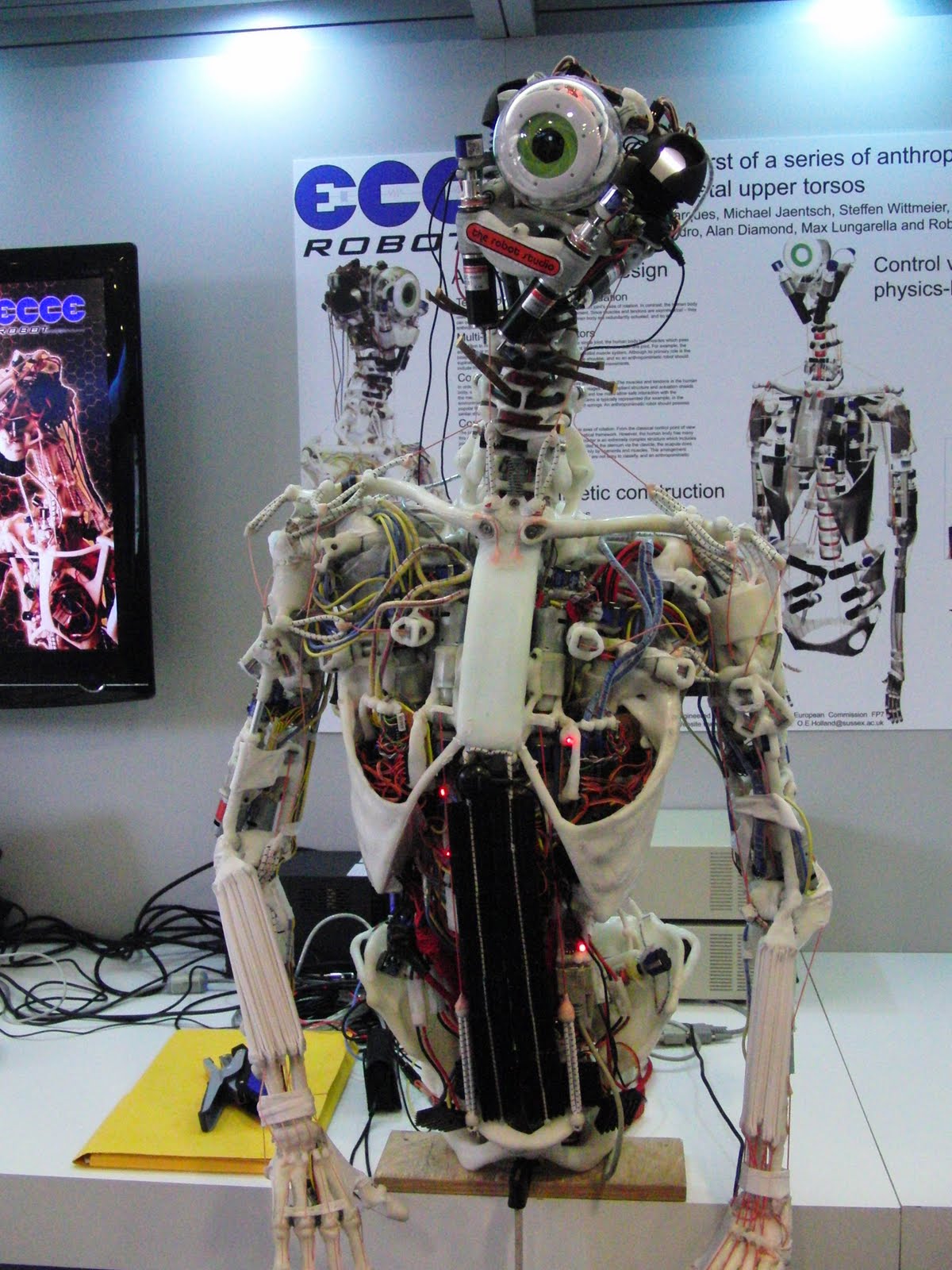
In the beginning you see a cyclops bot, the ECCE1: the first of a series of anthropomimetic musculoskelal upper torsos. That means its torso is designed to look very human-like, together with the noises from the servos it gives me quite a Terminator feeling (compare it to the ending scene of Terminator 1 movie if you don't believe me). This impression is reinforced by the calculations and identification routines that run down the computer screen while the bot is focusing on you to give you a tight handshake-
Our contribution to the conference was Istváns talk on "Complexity on the workbench" in the science cafe. Istvan had 20 x 20 seconds to present his ideas, where he started with the complexity problem, lead over to possible approaches to build complex self-organizing control systems and finally introduced our framework Frevo from our project MESON as a hands-on tool to practically build such systems.
Next station is the artificial eel bot that is moving around in a water bassin. A nice example of bio-inspired engineering. Still I hope that they don't make it a tool like a colonoscope out of it - just too creepy :-)
The cooperating robots had an interesting setup - the composition of ground robots, a flying multicopter and a robot that can lift itself up a rope. In cooperation, the bots could for example find, grab and fetch a particular book from a shelf. This will save me the way to the library in the future :-)
Another bio-inpired research is on octopus limbs. The biological ones are amazing regarding their adaptibility in length and thickness and their strength. Several research group investigate how these mechanisms can be converted to a technology for robot manipulators. In the video, you can see a first prototype.
The elected winner of the exhibition, was "the future of biomimetic machines", featuring iCub, a humanoid robot used as a platform to study perception and learning processes. In the video, you can see the cute robot following and catching a ball. Considering that the winner at FET'09 was a project featuring a Nao robot, one can conclude: "cuteness wins" :-)
Neither cute nor creepy are the robots from the SYMBRION/REPLICATOR project - they are whatever you want them to be. In the video you can see several parts assembling themselves, very impressive, although the docking mechanism still needs a bit of tuning.
These have been a selection out of approximately 30 demonstrations at FET'11. If you are more interested, go an visit FET next time for yourself, see you there :-)

Thursday, April 7, 2011

Lakeside Research Days 2011: Applications of self-organization in technology

The concept and theory of complex systems and self-organization has been researched for several decades and yielded many publications. Scientists claim self-organization to be the new paradigm to cope with the emerging complexity of networked applications. However, the claimed paradigm change has not yet shown a very great impact so far. Typical applications which are claimed to implement and build on self-organization are often built by experts from the respective domain such as computer networks, wireless communications, sensor networks, etc. without generality that holds also for other domains. On the other hand, research and development on applications of self-organization have the potential to provide results across the particular domain borders. In order to enable this potential, there is a need to move the application area of self-organizing systems more towards the center of complex systems research. In other words, complex systems researcher need to learn how to apply their results and domain specific researchers need to learn more about the general aspects of self-organization. At the Research Days 2011, a group of internal researchers will discuss how this translation between complex systems theory, domain-specific theory, and practical application can be achieved.
The Research Days are an annual event concentrating on the core competence of Lakeside Labs - Self-organizing Networked Systems. During this workshop organized by Lakeside Labs GmbH in cooperation with the University of Klagenfurt, international experts devote themselves to a special topic in self-organization. The event is organized as a five days workshop in July. It takes place at Lakeside Labs in Klagenfurt am Wörthersee, Austria, near a beautiful lake and Alps scenery. Invited experts, local professors, and young researchers discuss and elaborate ideas in the field of Self-Organizing Systems (SOS). The main emphasis of the workshop is on soliciting discussions and creating new ideas regarding a topic related to self-organizing systems. The event greatly supports scientific exchange, networking, establishment of international collaborations, and joint research projects.
The following video gives a nice impression of the Research Days:


The Research Days 2011 will take place in the week of July 11-15, 2011. Please visit http://researchdays.lakeside-labs.com for further information.

Wednesday, August 4, 2010

At IWSOS'09 in Zurich

We went to Zurich, Switzerland to attend IWSOS 2009, the Fourth International Workshop on Self-Organizing Systems, which was held in December 9-11 2009. I gave a talk on A Survey of Models and Methods for Self-Organizing Networked Systems, which was joint work together with Raissa D'Souza, Christian Bettstetter, and Hermann de Meer. My colleague István presented a poster on Towards evolving cooperative behavior with neural controllers were we researched on the initial conditions which are necessary to evolve cooperative behavior.

A review on the Lakeside Research Days 2009

Beginning of last summer we organized the Lakeside Research Days 2009 at the Labeside Labs in Klagenfurt. The days, which took place for the second time, were an intensive one-week workshop full of discussions, talks, and group work on the topic of self-organizing systems. The speakers, all deeply involved in self-organizing systems research, included Alain Barrat, Christian Bettstetter, Francis Heylighen, Hermann de Meer, Raissa D'Souza, Marc Timme, Anne van Rossum, and myself. The event was very successful in providing new insights, creating ideas, enabling cooperations and, in general, creating the joy of science reminding me why I became a researcher.
Our colleague Christian Philipp made an excellent short movie capturing the atmosphere and spirit of the event:


IEEEXtreme 24 hours programming contest

I was asked to act as a proctor for the team "Quit pro Code" at the IEEEXtreme 2009 contest. Since the tasks of a proctor (mainly to take care of the team(s)) are small comparable to those who are actively participating, I had some time to analyze the contest and learn about its philosophy.
The team of three programmers was given a set of problems which they have to implement in their favorite programming language (at least C,C++,Java were supported). All problems came with an exact specification and a set of test cases. The evaluation of a solution was performed automatically via the Mooshak tool. Given that the contest organizers had chosen their testcases well, this meant that a solution had to be perfect up to the last bit and, in some cases, also performant enough in order to give points.
It was interesting to note that time appeared not to be a limiting factor for the success in the contest. How fast problems have been solved only influenced the ranking between teams with the same amount of points. Basically, this was a good choice, since it gave a motivation for the teams to sleep and eat regularly within the 24 hours in order to stay focused.
None of the exercises involved writing large or even moderate-sized programs. As far as I could see, the solutions of my team usually were below a length of 200 LOC. The trickiness was more in deriving the idea for the possible solution and implementing it well without errors. Also creating test cases with good coverage was a very demanded skill in the contest.
To conclude, although I thought before that the IEEEXtreme contest is an event for code "hackers", my opinion is now that some classic rules of software engineering still hold true for this event. The requirement that a solution had to be exactly correct did not allow for a sloppy or ad-hoc programming style, and thus the classic stages like specification of operational and performance qualification, design specification, implementation, black box and white box testing and validation could be observed. Since a team member spent only 2-3 hours on one problem, I could observe miniature software projects evolving in a fast-forward manner.
By the way, the team Quit pro Code finished place 25th out of over 700 participants from all over the world. So, I am very proud of the team that I was allowed to proctor!

See also