Showing posts with label swarm behavior. Show all posts

Wednesday, August 27, 2025

New Book: Engineering Swarms of Cyber-Physical Systems

We are excited to announce the release of our new book, Engineering Swarms of Cyber-Physical Systems, published by CRC Press in 2025. Authored by Melanie Schranz, Wilfried Elmenreich, and Farshad Arvin, this book is a vital resource for researchers, engineers, and students interested in swarm intelligence and cyber-physical systems (CPS).

This comprehensive guide covers the entire design cycle for applying swarm intelligence in CPS, including modeling, design, simulation, and deployment. Key features include:

  • Real-World Examples: Applications in robotics, manufacturing, and search and rescue.
  • Hands-On Approach: Programming examples that facilitate quick implementation of concepts.
  • Diverse Methodologies: Insights into classical and machine-learning design methods for swarm applications.
  • Simulation Insights: A chapter dedicated to simulation requirements and models.


Why We Wrote This Book

After years of research, we felt the need for a comprehensive resource that combines theoretical insights with practical applications. Our goal is to inspire creativity and provide the tools necessary for readers to embark on their own projects.

We invite you to explore Engineering Swarms of Cyber-Physical Systems yourself. We hope this book serves as a valuable resource for your research and engineering endeavors!


Melanie Schranz, Wilfried Elmenreich, Farshad Arvin. Engineering Swarms of Cyber-Physical Systems. CRC Press 2025. ISBN 978-1-032-04715-7. 

Wednesday, September 9, 2020

Swarm Intelligence and Cyber-Physical Systems


Swarm Intelligence (SI) is a popular multi-agent framework that has been originally inspired by swarm behaviors observed in natural systems, such as ant and bee colonies. In a system designed after swarm intelligence, each agent acts autonomously, reacts on dynamic inputs, and, implicitly or explicitly, works collaboratively with other swarm members without a central control. The system as a whole is expected to exhibit global patterns and behaviors.

When is it advantageous to use a Swarm approach?
The scaling principle depicts a range where a swarm
outperforms a linear system of the same size

Although well-designed swarms can show advantages in adaptability, robustness, and scalability, it must be noted that SI system have not really found their way from lab demonstrations to real-world applications, so far. This is particularly true for embodied SI, where the agents are physical entities, such as in swarm robotics scenarios.

In the paper 

Melanie Schranz, Gianni di Caro, Thomas Schmickl, Wilfried Elmenreich, Farshad Arvin, Ahmet Sekercioglu, and Micha Sende. Swarm Intelligence and Cyber-Physical Systems: Concepts, challenges and future trends. Swarm and Evolutionary Computation, 60, 2020. (doi:10.1016/j.swevo.2020.100762)

we start from these observations, outline different definitions and characterizations, and then discuss present challenges in the perspective of future use of swarm intelligence. These include application ideas, research topics, and new sources of inspiration from biology, physics, and human cognition. To motivate future applications of swarms, we make use of the notion of cyber-physical systems (CPS). CPSs are a way to encompass the large spectrum of technologies including robotics, internet of things (IoT), Systems on Chip (SoC), embedded systems, and so on. Thereby, we give concrete examples for visionary applications and their challenges representing the physical embodiment of swarm intelligence in

  • autonomous driving and smart traffic,
  • emergency response,
  • environmental monitoring,
  • electric energy grids,
  • space missions,
  • medical applications,
  • and human networks.

In the future, swarm-based applications will play an important role when there is not enough information to solve the problem in a centralized way, when there are time constraints which do not allow to find an analytical solution, and when the operation needs to be performed in a dynamically changing environment. With an increasing complexity in upcoming applications this will mean that SI will be applied to solve a significant part of ubiquitous complex problems.

Monday, July 27, 2020

Swarm Robotic Behaviors in Real-World Applications

Spiderino - a low-cost robot for swarm
research and educational purposes
With potential benefits from self-organization (e.g., resilience, scalability, and adaptivity to dynamic environments) the motivation is strong to apply swarm robotics in industrial applications. While there exist several swarm robotics research platforms that are developed for educational and scientific purposes, many industrial applications still rely on centralized control. Moreover, in cases where a multi-robot solution is employed, the principal idea of swarm robotics of distributed decision making is often not implemented. To address this topic, the paper

Melanie Schranz, Micha Sende, Martina Umlauft, and Wilfried Elmenreich. Swarm robotic behaviors and current applications. Frontiers in Robotics and AI, 7(36), 2020. (doi:10.3389/frobt.2020.00036)

The e-puck, a robot designed for
education in engineering
provides a collection and categorization of swarm robotic behaviors. Along with this taxonomy, the paper gives a comprehensive overview of research platforms and industrial projects and products, separated into terrestrial, aerial, aquatic, and outer space. In a final discussion, the authors identify several open issues including dependability, emergent characteristics, security and safety, communication as hindrances for the implementation of fully distributed autonomous swarm systems.

The paper was published as part of a Research Topic on Designing Self-Organization in the Physical Realm in the Frontiers in Robotics and AI journal.

In another paper in this issue,

Danesh Tarapore, Roderich Groß, and Klaus-Peter Zauner. Sparse robot swarms: Moving swarms to real-world applications. Frontiers in Robotics and AI, 7(36), 2020. (doi:10.3389/frobt.2020.00083)

the authors address a common property of swarms: the underlying assumption that the robots act in close proximity of each other (for example a few body lengths apart), and typically employ uninterrupted, situated, close-range communication for coordination. Many real-world applications, including environmental monitoring and precision agriculture, however, require scalable groups of robots to act jointly over larger distances (e.g., 1000 body lengths), rendering the use of dense swarms impractical. Using a dense swarm for such applications would be invasive to the environment and unrealistic in terms of mission deployment, maintenance, and post-mission recovery. To address this problem, the paper proposes a sparse swarm concept, which is illustrated via four application scenarios.

Wednesday, November 16, 2016

Two Open PhD Student Positions at Alpen-Adria-Universität Klagenfurt, Austria

The Institute of Networked and Embedded Systems at the University of Klagenfurt, Austria, has an opening for two researchers (PhD student) in Self-Organizing Networked Systems.

You will work in an European project on Cyber-Physical Systems. The project duration is three years. Research will be conducted at the Smart Grids group at the Institute of Networked and Embedded Systems under the supervision of Professor Wilfried Elmenreich. Working language is English. The institute cooperates with national and international partners from industry and academia and is part of the research cluster Lakeside Labs (self-organizing networked systems).

Our team is very international and dedicated to quality research and teaching. The offices and laboratories are located in the well-equipped Lakeside Science & Technology Park. Working language is English. The Institute cooperates with national and international partners in research and industry. It is part of the research cluster Lakeside Labs on self-organizing networked systems.

The candidate is expected to have a master in electrical or computer engineering, computer science, applied mathematics or equivalent. Experience in one or more of the following fields is required:
  • Distributed and swarm algorithms
  • Genetic algorithms and evolutionary design
  • Very good programming skills in Java

The contract will be based on 30 hours per week with a gross salary of at least 28314 EUR per year. Please mail applications containing a letter of interest, curriculum vitae, copies of academic certificates and courses, list of publications, and contact details of two references in a single PDF file to wilfried.elmenreich@aau.at before January 12, 2016. Women are especially encouraged to apply.

Thursday, February 5, 2015

Simulating Swarm Behavior with Scratch

My young audience
Today I was giving a lecture to kids at age 8 to 12 at our University. The lecture was part of an initiative called “Kinderuni” (Children’s University) which aims at increasing awareness of our academic business already at young age.
In my lecture I approached the general topic of computer software by the example of the programming language Scratch. Scratch is a graphical programming language designed by the Lifelong Kindergarten Group at the MIT media lab. The language aims to be simple, colorful and fun in order to enable and motivate children at a young age to create programs with their own ideas.
I explained how Scratch works and together the kids and I coded a simple computer game in 25 minutes, which was definitely a challenge to do this in this short time. Another challenge was to create the connection between making a simple game with scratch and doing research at a university. However, this might be easier than you think. While Scratch is in general a programming language for kids, it can be actually useful to explore and demonstrate multi-agent behavior with comparably little effort. Especially with the introduction of cloned objects in Scratch 2.0, the implementation of swarm behavior with a variable number of interacting agents became easy.

http://scratch.mit.edu/studios/215351/
Some projects from swarm behavior studio

The Scratch Studio Swarm Behavior gathers online simulations and games related to swarm behavior, multi-agent systems, clone interactions, self-organizing systems, and artificial life. The simulations show how Scratch can be used to demonstrate swarm behavior and how such a simulation can be implemented. Scratch is of course of low value regarding functionalty and performance - so you might have to drop the idea of having kindergarten kids coding the simulations for your next journal paper ;-).

Friday, July 4, 2014

On Evolving Self-organizing Technical Systems

Moofushi Kandu fish (Image by Bruno
de Giusti under CC-BY-SA-2.5)
Individual swarm fish behave according to simple rules, which make the overall swarm an efficient entitiy for hunting and avoiding predators. Despite the simple local rules, a school of fish is a working, intelligent system. István Fehervari examined in his doctoral thesis how this behavior can be transferred to technical systems. The result is a tool making it easier to develop self-organizing systems.
Sometimes, it is possible to mimic natural self-organizing behavior for a technical system. At other times, you might not have access to such a template. "If there is no natural system, which we can copy, we have to develop it on our own," says István Fehérvári from the Institute of Networked and Embedded Systems at Alpen-Adria-Universität Klagenfurt. Fehérvári further explains: "This is very difficult because the behavior of a complex system is difficult to predict and the definition of the proper interaction behaviors is hard. Any change in the system creates an effect, often with unwanted consequences. This is why we apply an artificial evolution approach to evolve the local interaction rules,"

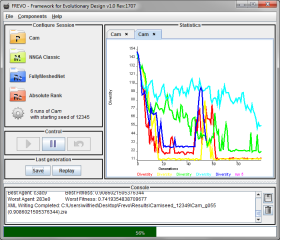
To make this approach feasible, the FREVO software has been developed, a tool that helps to apply the evolutionary approach in a unified way to different problem statements and settings. "FREVO provides a one-stop shop, with all the necessary steps for designing a self-organized algorithm for a given problem." says Fehérvári who devoted a major part of his thesis work to design and implement FREVO.  Now the tool is available to other researchers for further experiments and investigations. FREVO is an open-source program in Java that can be freely downloaded at frevo.sourceforge.net

Further readings and downloads:

Sunday, April 20, 2014

The Next Big Thing in Artificial Evolution

As announced in a previous blogpost, Prof. A. E. Eiben gave a very interesting talk on the next big in thing in artificial evolution during his visit at the Alpen-Adria-Universität Klagenfurt. Eiben presented a vision about having animate artefacts that are able to evolve and self-reproduce in physical spaces. To make this happen, he gives a notion of the integration of "hard" vs. "soft" evolutionary computation, the former meaning evolutionary optimiziation and design while the latter refering to artificial life, swarm robotics, and artificial societies.


Gusz Eiben's talk was attracting many people and lead to a vivid discussion afterwards about technology, possibilities, societal implications and parallels to existing sci-fi stories from Philip K. Dick or movies such as Terminator. So I think it is appropriate to say this talk was truly presenting science beyond fiction.

Tuesday, April 15, 2014

How the body affects the mind - On the effects of robot configuration on evolved behavior

The design of robotic controllers through evolutionary methods requires making a large number of choices about the experimental setup, which are often left to the expertise or naïveté of the experimenter. Although much attention is normally given to the fitness function or the genotype-to-phenotype mapping determining the robot controller, the robot configuration is often selected with little care. Yet, an ill-defined configuration - in terms of the selected subset of the sensory-motor system, or in the pre-processing of the raw sensor data - may be decisive in determining the failure of the evolutionary process.

Different emerged patterns 
simulated with ARGoS
In our paper "On the effects of the robot configuration on evolving coordinated motion behaviors" we studied the effect of different robot configurations on the ability to evolve efficient behaviors for a swarm robotics system. In this domain, the choice of a good configuration is fundamental as even small details can lead to large differences in the group behavior. To demonstrate the importance of the robot configuration, we test different alternatives and measure the group performance on a bi-objective scale.

The results show that different configurations not only have a strong effect on performance, but they also correspond to behaviors with radically different features concerning the organization of the group.

The following video illustrates three basic behaviors that emerged: wavefront, train and flocking:


For more information, see:

I. Fehérvári, V. Trianni, and W. Elmenreich. On the effects of the robot configuration on evolving coordinated motion behaviors. In Proceedings of the IEEE Congress on Evolutionary Computation. IEEE, June 2013.