Showing posts with label self-organization. Show all posts

Wednesday, August 27, 2025

New Book: Engineering Swarms of Cyber-Physical Systems

We are excited to announce the release of our new book, Engineering Swarms of Cyber-Physical Systems, published by CRC Press in 2025. Authored by Melanie Schranz, Wilfried Elmenreich, and Farshad Arvin, this book is a vital resource for researchers, engineers, and students interested in swarm intelligence and cyber-physical systems (CPS).

This comprehensive guide covers the entire design cycle for applying swarm intelligence in CPS, including modeling, design, simulation, and deployment. Key features include:

  • Real-World Examples: Applications in robotics, manufacturing, and search and rescue.
  • Hands-On Approach: Programming examples that facilitate quick implementation of concepts.
  • Diverse Methodologies: Insights into classical and machine-learning design methods for swarm applications.
  • Simulation Insights: A chapter dedicated to simulation requirements and models.


Why We Wrote This Book

After years of research, we felt the need for a comprehensive resource that combines theoretical insights with practical applications. Our goal is to inspire creativity and provide the tools necessary for readers to embark on their own projects.

We invite you to explore Engineering Swarms of Cyber-Physical Systems yourself. We hope this book serves as a valuable resource for your research and engineering endeavors!


Melanie Schranz, Wilfried Elmenreich, Farshad Arvin. Engineering Swarms of Cyber-Physical Systems. CRC Press 2025. ISBN 978-1-032-04715-7. 

Tuesday, February 9, 2021

An Artificial Hormone-based Algorithm for Production Scheduling

Artificial hormone systems are inspired by the natural endocrine system that adjusts the metabolism of tissue cells in our body. By connecting decisions and actions in a system to the production and evaporation of artificial hormones, it is possible to create a bio-inspired self-organizing algorithm.

Application areas for such algorithms are problems with many agents to be coordinated, where existing optimization approaches come to their limit. An example of such a problem is the production of logic and power integrated circuits (ICs) in the semiconductor industry. Unlike the high-volume production of memory ICs, wafer production in the logic and power sector has a large product mix. This involves many processing steps and dynamic changes of involved machines.

Weekly workloads can involve around 100 000 operations on thousands of machines. Optimizing such a system for work in progress and flow factor is an NP-hard problem. At this size, existing dispatching rules and linear optimization methods cannot cope with the NP-hard search space, thus not optimize the entire system.

To address this issue, we have modeled a production plant as a self-organizing system of agents that interact with each other in a non-linear way. As it is common in the semiconductor industry, wafers are combined in groups of 25 pieces forming a so-called lot. In our approach, an artificial hormone systems is used to express a lot's urgency and the need for new lots at a machine type, thus providing a system using local information for optimization. The algorithm builds upon five principles, which are 

  • (i) machines produce hormone to attract lots, 
  • (ii) hormone diffuses process-upstream, 
  • (iii) incoming lots diffuse hormone, 
  • (iv) lots are prioritized by their timing, and 
  • (v) lots are attracted by hormone. 

Via these mechanisms, machines can balance their workload by pulling required lots towards them. The algorithm has been implemented and evaluated in a NetLogo simulation model. Simulation results indicate that the artificial hormone system improves around 5% for overall production time and flow factor compared to a baseline algorithm. Future work will investigate if the hormone algorithm can be used on top of existing production systems. In a productive system an improvement of 5% would be highly notable.

More information can be found on the SWILT project webpage and in the paper

Wilfried Elmenreich, Alexander Schnabl, and Melanie Schranz. An artificial hormone-based algorithm for productionscheduling from the bottom-up. In Proceedings of the 13th International Conference on Agents and Artificial Intelligence. SciTePress, February 2021.

Click triangle for Bibtex entry
@inproceedings{elmenreich:Hormone:21,
  author = {Elmenreich, Wilfried and Schnabl, 
    Alexander and Schranz, Melanie},
  title = {An artificial hormone-based algorithm
    for production scheduling from the bottom-up},
  booktitle = {Proceedings of the 13th International 
    Conference on Agents and Artificial Intelligence},
  year = {2021},
  month = feb,
  publisher = {SciTePress}
}  
  

Wednesday, September 9, 2020

Swarm Intelligence and Cyber-Physical Systems


Swarm Intelligence (SI) is a popular multi-agent framework that has been originally inspired by swarm behaviors observed in natural systems, such as ant and bee colonies. In a system designed after swarm intelligence, each agent acts autonomously, reacts on dynamic inputs, and, implicitly or explicitly, works collaboratively with other swarm members without a central control. The system as a whole is expected to exhibit global patterns and behaviors.

When is it advantageous to use a Swarm approach?
The scaling principle depicts a range where a swarm
outperforms a linear system of the same size

Although well-designed swarms can show advantages in adaptability, robustness, and scalability, it must be noted that SI system have not really found their way from lab demonstrations to real-world applications, so far. This is particularly true for embodied SI, where the agents are physical entities, such as in swarm robotics scenarios.

In the paper 

Melanie Schranz, Gianni di Caro, Thomas Schmickl, Wilfried Elmenreich, Farshad Arvin, Ahmet Sekercioglu, and Micha Sende. Swarm Intelligence and Cyber-Physical Systems: Concepts, challenges and future trends. Swarm and Evolutionary Computation, 60, 2020. (doi:10.1016/j.swevo.2020.100762)

we start from these observations, outline different definitions and characterizations, and then discuss present challenges in the perspective of future use of swarm intelligence. These include application ideas, research topics, and new sources of inspiration from biology, physics, and human cognition. To motivate future applications of swarms, we make use of the notion of cyber-physical systems (CPS). CPSs are a way to encompass the large spectrum of technologies including robotics, internet of things (IoT), Systems on Chip (SoC), embedded systems, and so on. Thereby, we give concrete examples for visionary applications and their challenges representing the physical embodiment of swarm intelligence in

  • autonomous driving and smart traffic,
  • emergency response,
  • environmental monitoring,
  • electric energy grids,
  • space missions,
  • medical applications,
  • and human networks.

In the future, swarm-based applications will play an important role when there is not enough information to solve the problem in a centralized way, when there are time constraints which do not allow to find an analytical solution, and when the operation needs to be performed in a dynamically changing environment. With an increasing complexity in upcoming applications this will mean that SI will be applied to solve a significant part of ubiquitous complex problems.

Monday, July 27, 2020

Swarm Robotic Behaviors in Real-World Applications

Spiderino - a low-cost robot for swarm
research and educational purposes
With potential benefits from self-organization (e.g., resilience, scalability, and adaptivity to dynamic environments) the motivation is strong to apply swarm robotics in industrial applications. While there exist several swarm robotics research platforms that are developed for educational and scientific purposes, many industrial applications still rely on centralized control. Moreover, in cases where a multi-robot solution is employed, the principal idea of swarm robotics of distributed decision making is often not implemented. To address this topic, the paper

Melanie Schranz, Micha Sende, Martina Umlauft, and Wilfried Elmenreich. Swarm robotic behaviors and current applications. Frontiers in Robotics and AI, 7(36), 2020. (doi:10.3389/frobt.2020.00036)

The e-puck, a robot designed for
education in engineering
provides a collection and categorization of swarm robotic behaviors. Along with this taxonomy, the paper gives a comprehensive overview of research platforms and industrial projects and products, separated into terrestrial, aerial, aquatic, and outer space. In a final discussion, the authors identify several open issues including dependability, emergent characteristics, security and safety, communication as hindrances for the implementation of fully distributed autonomous swarm systems.

The paper was published as part of a Research Topic on Designing Self-Organization in the Physical Realm in the Frontiers in Robotics and AI journal.

In another paper in this issue,

Danesh Tarapore, Roderich Groß, and Klaus-Peter Zauner. Sparse robot swarms: Moving swarms to real-world applications. Frontiers in Robotics and AI, 7(36), 2020. (doi:10.3389/frobt.2020.00083)

the authors address a common property of swarms: the underlying assumption that the robots act in close proximity of each other (for example a few body lengths apart), and typically employ uninterrupted, situated, close-range communication for coordination. Many real-world applications, including environmental monitoring and precision agriculture, however, require scalable groups of robots to act jointly over larger distances (e.g., 1000 body lengths), rendering the use of dense swarms impractical. Using a dense swarm for such applications would be invasive to the environment and unrealistic in terms of mission deployment, maintenance, and post-mission recovery. To address this problem, the paper proposes a sparse swarm concept, which is illustrated via four application scenarios.

Monday, May 11, 2020

Remember the Conferences?

After a couple of weeks in self-isolation due to the global epidemic of the COVID-19 virus, we are getting used to having conferences entirely online. To cheer you up we are posting some impressions from one of our last conference visits that actually took place physically.
Casa Convalescència

We had been at WiMob 2019, the 15th International Conference on Wireless and Mobile Computing, Networking and Communications. The event brought together top researchers and practitioners and created a forum for the exchange of experience and knowledge among researchers and developers concerned with wireless and mobile technology.
In addition to presenting our paper at a top conference, we also enjoyed the nice conference place - the event took place in Barcelona and was organized at the venerable Casa Convalescència. The building is one of the great works of Catalan Modernism, and was declared Historical Artistic Monument in 1978 and World Cultural Heritage Site by UNESCO in 1997. The building is part of the historic site of the Hospital de la Santa Creu i Sant Pau.
Plenary at WiMob'19

Being in such an inspiring environment, the conference went great. Martina Umlauft presented our paper "Topology Characterization for Position-based Wireless Network Topology Generators" in front of an interesting crowd with great success. In the paper, we discuss methods to characterize network topology based solely on the spatial positions of the nodes on the terrain are necessary. Topologies are usually characterized in terms of their network graph; usually by investigating their degree frequency, rank/degree, or hop/count distributions. Wireless network simulation, on the other hand, typically does not use network graphs. Instead, in most wireless simulations, nodes are first positioned on the terrain based on some positioning algorithm and then a radio propagation model is used to determine connectivity dynamically at simulation run-time. We propose several metrics and show how they can be used to evaluate position-based topologies: the nearest neighbor distance distribution, a threshold, and a probabilistic node degree measure, and the application of an inhomogeneity measure for spatial distributions.

Please find the presented paper here:

Martina Umlauft and Wilfried Elmenreich. Topology Characterization for Position-based Wireless Network Topology Generators. In Anna Maria Vegni, editor, 15th International Conference on Wireless and Mobile Computing, Networking and Communications (WiMob 2019), Piscataway (NJ), Oktober 2019. IEEE.

We hope this little report helped to remember the better times. See you hopefully soon at the next real conference ;-)


Friday, February 7, 2020

The Wisdom of Crowds or Can many mediocre measurements produce a single good one?

In the introduction of his excellent book "The Wisdom of Crowds" James Surowiecki tells the story of the British Scientist Francis Galton who went to a country fair in 1906. There, a guessing game took place where one had to guess the weight of a bull.
800 people purchased a ticket and delivered their estimates on paper. Galton, who was curious about all kinds of things (I already told you he was a scientist, right) borrowed the tickets afterward and analyzed the results. He was expecting the average of the guesses to be far off because for each expert in the crowd (like for example a butcher) there were for sure a couple of inexperienced people. However, to his great surprise, the average guess of 1197 pounds was very close to the real result of 1198 pounds! This story, by the way, also documents the increase in weight of livestock - today a bull would be around twice as heavy!

If you are interested in the further aspects of collective human intelligence, I recommend reading the book:

James Surowiecki, The Wisdom of Crowds, Anchor, 2005.

But I was less interested in people, instead, I was wondering if this can be used for combining sensor measurements.

A couple of years ago I worked on a method for combining measurements from sensors with different accuracy. Translated to the story above this would mean if we know who are the experts and who are not, should we even bother to include the results of the latter? Actually, the answer is yes - given that the estimates have low correlation! But other than in the story above, the best way is to do a weighted average of values. The weights are derived from the error variance of the estimates, so a sensor with high error variance should get a low weight and a sensor with low error variance should get a high weight.

The resulting formula is surprisingly easy:
The paper explaining the approach in detail and showing how this can be integrated into a sensor network can be found here (link leads to freely accessible PDF):

W. Elmenreich. Fusion of continuous-valued sensor measurements using confidence-weighted averaging. Journal of Vibration and Control, 13(9-10):1303–1312, 2007. (doi:10.1177/1077546307077457)

So, just in case you have to guess the weight of a bull at a country fair, remember this approach :-)

Wednesday, May 3, 2017

Research Days on Self-Organization and Swarm Intelligence in Cyber Physical Systems

July 10 – 12, 2017
Lakeside Labs
Klagenfurt, Austria

Systems with swarm intelligence consist of a set of agents, with local intelligence, interacting locally. Typically, approaches for swarm intelligence come from biological systems, like ant or bee colony behavior, schooling of fishes, flocking of birds, etc. As the agents follow very simple rules without a central control dictating their activities, the interactions between those agents lead to the emergence of intelligent or complex global behavior. In other words, CPS researchers need to learn how to construct and apply techniques for self- organization and swarm intelligence, their opportunities and challenges.

At the Research Days 2017, a group of international researchers will discuss how this translation between CPS, self-organization, and swarm intelligence can be achieved on a theoretical and practical basis. The Research Days are a regular event concentrating on the core competence of Lakeside Labs - Self-organizing Networked Systems. During this workshop organized by Lakeside Labs GmbH in cooperation with the University of Klagenfurt, international experts devote themselves to a special topic in self-organization. The event is organized as a workshop of several consecutive days in July. It takes place at Lakeside Labs in Klagenfurt am Wörthersee, Austria, near a beautiful lake and Alps scenery. Invited experts, local professors, and young researchers discuss and elaborate ideas in the field of Self-Organizing Systems (SOS). The main emphasis of the workshop is on soliciting discussions and creating new ideas regarding a topic related to self-organizing systems. The event greatly supports scientific exchange, networking, establishment of international collaborations, and joint research projects.

The following video gives a nice impression of the Research Days:
Learn more and registerfor the event at https://researchdays.lakeside-labs.com/

Wednesday, November 16, 2016

Two Open PhD Student Positions at Alpen-Adria-Universität Klagenfurt, Austria

The Institute of Networked and Embedded Systems at the University of Klagenfurt, Austria, has an opening for two researchers (PhD student) in Self-Organizing Networked Systems.

You will work in an European project on Cyber-Physical Systems. The project duration is three years. Research will be conducted at the Smart Grids group at the Institute of Networked and Embedded Systems under the supervision of Professor Wilfried Elmenreich. Working language is English. The institute cooperates with national and international partners from industry and academia and is part of the research cluster Lakeside Labs (self-organizing networked systems).

Our team is very international and dedicated to quality research and teaching. The offices and laboratories are located in the well-equipped Lakeside Science & Technology Park. Working language is English. The Institute cooperates with national and international partners in research and industry. It is part of the research cluster Lakeside Labs on self-organizing networked systems.

The candidate is expected to have a master in electrical or computer engineering, computer science, applied mathematics or equivalent. Experience in one or more of the following fields is required:
  • Distributed and swarm algorithms
  • Genetic algorithms and evolutionary design
  • Very good programming skills in Java

The contract will be based on 30 hours per week with a gross salary of at least 28314 EUR per year. Please mail applications containing a letter of interest, curriculum vitae, copies of academic certificates and courses, list of publications, and contact details of two references in a single PDF file to wilfried.elmenreich@aau.at before January 12, 2016. Women are especially encouraged to apply.

Monday, April 6, 2015

Call for Papers Ninth IEEE International Conference on Self-Adaptive and Self-Organizing Systems (SASO 2015)

 The Ninth IEEE International Conference on Self-Adaptive and Self-Organizing Systems (SASO 2015)

Boston Massachusetts; 21-25 September 2015

Part of FAS* - Foundation and Applications of Self* Computing Conferences

Colocated with:

Aims and Scope

http://en.wikipedia.org/wiki/BostonThe aim of the Self-Adaptive and Self-Organizing systems conference series (SASO) is to provide a forum for the foundations of a principled approach to engineering systems, networks and services based on self-adaptation and self-organization. The complexity of current and emerging networks, software and services, especially in dealing with dynamics in the environment and problem domain, has led the software engineering, distributed systems and management communities to look for inspiration in diverse fields (e.g., complex systems, control theory, artificial intelligence, sociology, and biology) to find new ways of designing and managing such computing systems. In this endeavor, self-organization and self-adaptation have emerged as two promising interrelated approaches. They form the basis for many other self-* properties, such as self-configuration, self-healing, or self-optimization. Systems exhibiting such properties are often referred to as self-* systems.

The ninth edition of the SASO conference embraces the inter-disciplinarity and the scientific, empirical, and application dimensions of self-* systems and welcomes novel results on both self-adaptive and self-organizing systems research. The topics of interest include, but are not limited to:

  • Self-* systems theory: theoretical frameworks and models; biologically- and socially-inspired paradigms; inter-operation of self-* mechanisms;
  • Self-* systems engineering: reusable mechanisms, design patterns, architectures, methodologies; software and middleware development frameworks and methods, platforms and toolkits; hardware; self-* materials;
  • Self-* system properties: robustness, resilience and stability; emergence; computational awareness and self-awareness; reflection;
  • Self-* cyber-physical and socio-technical systems: human factors and visualization; self-* social computers; crowdsourcing and collective awareness; human-in-the-loop;
  • Applications and experiences of self-* systems: cyber security, transportation, computational sustainability, big data and creative commons, power systems; swarm systems and robotics.
  • Self-* in education: experience reports; curricula; innovative course concepts; methodological aspects of self-* systems education

Contributions must present novel theoretical or experimental results; novel design patterns, mechanisms, system architectures, frameworks or tools; or practical approaches and experiences in building or deploying real-world systems and applications. Contributions contrasting different approaches for engineering a given family of systems, or demonstrating the applicability of a certain approach for different systems, are equally encouraged. Likewise, papers describing substantial innovation or insights in the use and communication of self-* systems in the classroom are welcome.

Where relevant and appropriate, accepted papers will also be encouraged to participate in the Demo or Poster Sessions.

Important Dates

Abstract submission: May 8, 2015
Paper submission: May 22, 2015 (There will be no extensions of this deadline)
Notification: June 30, 2015
Camera ready copy due: July 17, 2015
Conference: September 21-25, 2015

Submission Instructions

All submissions should be 10 pages and formatted according to the IEEE Computer Society Press proceedings style guide and submitted electronically in PDF format.
Please register as authors and submit your papers using the SASO 2015 conference management system, which is located at:

https://www.easychair.org/conferences/?conf=saso2015

The proceedings will be published by IEEE Computer Society Press, and made available as a part of the IEEE digital library. Note that a separate call for poster submissions has also been issued.
Review Criteria

Papers should present novel ideas in the cross-disciplinary research context described in this call, clearly motivated by problems from current practice or applied research.

We expect both theoretical and empirical contributions to be clearly stated, substantiated by formal analysis, simulation, experimental evaluations, comparative studies, and so on. Appropriate reference must be made to related work. Because SASO is a cross-disciplinary conference, papers must be intelligible and relevant to researchers who are not members of the same specialized sub-field. Authors are also encouraged to submit papers describing applications. Application papers are expected to provide an indication of the real world relevance of the problem that is solved, including a description of the deployment domain, and some form of evaluation of performance, usability, or comparison to alternative approaches. Experience papers are also welcome, but they must clearly state the insight into any aspect of design, implementation or management of self-* systems which is of benefit to practitioners and the SASO community

Conference General Chairs

  • Howard E. Shrobe, MIT CSAIL, Cambridge, MA, USA
  • Julie A. McCann, Imperial College London, UK

Program Chairs


  • Emma Hart, Edinburgh Napier University
  • Gregory Sullivan, BAE Systems AIT
  • Jan-Philipp Steghöfer, University of Gothenburg, Sweden

Friday, February 27, 2015

SEAHORSE: A Middleware for Search and Delivery of Information Units based on an Artificial Hormone System Algorithm

SEAHORSE structure
With the rise of networked smart devices and the so called Internet of Things, services require more scalability and robustness to handle the complexity of the underlying ecosystem. In some situations (e.g., disaster areas, large-area sports events, battle fields, etc.), a traditional network infrastructure does not exist, or is expensive to set up. In this context content is also consumed in a more dynamic way than in traditional environments. By looking at principles found in nature we can see that it is possible to handle complexity and dynamics by relying exclusively on simple, local decisions (bio-inspired self-organizing systems). As an example, ants are exploring the surrounding area to find food, and if found they go back to their home base leaving pheromones to guide other ants.
We introduce SEAHORSE, a middleware showing by example how an existing self-organizing algorithm can be generalized. SEAHORSE is a first step for bringing self-organizing algorithms towards real-world applications.
By specifying interfaces to the application the middleware transparently handles the distribution of content. We show two use cases from different technical fields and performed a parameter analysis to reduce the configuration effort.

A. Sobe, W. Elmenreich, T. Skalicky, and L. Böszörmenyi. SEAHORSE: Generalizing an artificial hormone system algorithm to a middleware for search and delivery of information units. Elsevier Journal of Computer Networks, 2015.

Friday, February 13, 2015

FREVO 1.2 release

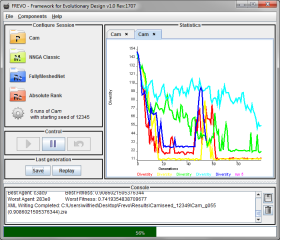
FREVO 1.2 - new version of the Framework for Evolutionary DesignWe proudly announce the new release 1.2 of FREVO (FRamework for EVOlutionary design). FREVO helps to reduce the time to implement, set up and run an evolutionary algorithm to evolve an agent's behavior as a solution to a particular control problem. FREVO supports decomposing the task into problem definition, solution representation and the optimization method. The componentwise separation allows to experiment with different combinations of algorithms and neural networks for different tasks.

The following components were added to FREVO:

  • HEMS  a simulation for modeling trading behavior of loads and local energy generators.
  • SinglePong  a simulation of the one player pong game where several paddles can cooperate in order to achieve better performance.
  • Pong  a simulation of the pong game where two teams can play against each other.

Quick start:
  • download the newest version at frevo.sourceforge.net 
  • unpack the ZIP file
  • unless you have it already on your system, install Java 
  • execute the createscrips.jar ("java -jar createscrips.jar") 
  • you can now run FREVO using the script named launch_Frevo 
...or have a look at the following video explaining the basic steps to get started with FREVO:
For more information see the following sources:

Thursday, February 5, 2015

Simulating Swarm Behavior with Scratch

My young audience
Today I was giving a lecture to kids at age 8 to 12 at our University. The lecture was part of an initiative called “Kinderuni” (Children’s University) which aims at increasing awareness of our academic business already at young age.
In my lecture I approached the general topic of computer software by the example of the programming language Scratch. Scratch is a graphical programming language designed by the Lifelong Kindergarten Group at the MIT media lab. The language aims to be simple, colorful and fun in order to enable and motivate children at a young age to create programs with their own ideas.
I explained how Scratch works and together the kids and I coded a simple computer game in 25 minutes, which was definitely a challenge to do this in this short time. Another challenge was to create the connection between making a simple game with scratch and doing research at a university. However, this might be easier than you think. While Scratch is in general a programming language for kids, it can be actually useful to explore and demonstrate multi-agent behavior with comparably little effort. Especially with the introduction of cloned objects in Scratch 2.0, the implementation of swarm behavior with a variable number of interacting agents became easy.

http://scratch.mit.edu/studios/215351/
Some projects from swarm behavior studio

The Scratch Studio Swarm Behavior gathers online simulations and games related to swarm behavior, multi-agent systems, clone interactions, self-organizing systems, and artificial life. The simulations show how Scratch can be used to demonstrate swarm behavior and how such a simulation can be implemented. Scratch is of course of low value regarding functionalty and performance - so you might have to drop the idea of having kindergarten kids coding the simulations for your next journal paper ;-).

Monday, November 24, 2014

Scalability in Self-Organizing Systems

One of the properties of self-organizing systems is scalability. It means that system keeps its working capabilities even if we remove some of its components or add more of them. In our reseach, we employ different evolutionary algorithms (EAs) to create a self-organizing system. In particular, algorithms like a simple evolutionary algorithm or a two dimensional cellular EA are used  for adjusting the synaptic weights of an neural controller. The best solutions are identified based on simulations of the target application. Typically, the simulation parameters limit the applicability of the solution - there is no guarantee that an evolved solution is adaptable or scalable to situations not specified in the simulation parameters. On the other hand, there are many examples in nature where solutions could be successfully employed in other contexts. We decided to check how our soccer teams, which consist of evolved neural controllers, can scale.

For the FIFA World Cup in Brazil we organized our own tournament between evolved self-organized soccer teams. This is an exciting show - to see how simple agents having only partial information about the environment around them are reaching its goal (score a goal) as a team. Will they be able to play in the same manner if we take the contoller, trained in the simulation with 10 players per team, and increase or decrease the number of players? This question has remained open until today.

In our first scenario, we assume that we invited two soccer teams to show us a fantastic game, but due to some circumstances, only 4 players per teamshow up.
Thus our first experiment can be seen in the video below.
Despite the players being evolved in a context of 11 players on each side, reducing the number of players did not affect the ability of players to show good game.


To check the other extreme, we settled a very dangerous experiment - each team consisting of 40 players! The results were stunning (see video below). These soccer heroes could play as a team even with significantly increased number of players. Unfortunately, they could not play for a long time in this mode: Marco Materazzi headbutted Zinadine Zidane in the chest and shouted "Revenge!"; Luis Suarez bit two players in order to show his perfect teeth; Diego Maradona scored the goal by striking the ball with his hand and this time he was disqualified for this trick. We didn't care about these incidents since we got the results of our experiment:


Links:

Sunday, October 12, 2014

Self-organizing Processes in Physical Geography

In this talk, Marco van der Wiel presents some ideas on self-organization and self-organized criticality, and how these relate to physical geography and (explanatory and exploratory) modelling in physical geography.


Loading video...
The talk is in english, you might want to skip the german introduction until 1:40. Video by AAU Campus TV/Egmont Sparouz.

Friday, July 4, 2014

On Evolving Self-organizing Technical Systems

Moofushi Kandu fish (Image by Bruno
de Giusti under CC-BY-SA-2.5)
Individual swarm fish behave according to simple rules, which make the overall swarm an efficient entitiy for hunting and avoiding predators. Despite the simple local rules, a school of fish is a working, intelligent system. István Fehervari examined in his doctoral thesis how this behavior can be transferred to technical systems. The result is a tool making it easier to develop self-organizing systems.
Sometimes, it is possible to mimic natural self-organizing behavior for a technical system. At other times, you might not have access to such a template. "If there is no natural system, which we can copy, we have to develop it on our own," says István Fehérvári from the Institute of Networked and Embedded Systems at Alpen-Adria-Universität Klagenfurt. Fehérvári further explains: "This is very difficult because the behavior of a complex system is difficult to predict and the definition of the proper interaction behaviors is hard. Any change in the system creates an effect, often with unwanted consequences. This is why we apply an artificial evolution approach to evolve the local interaction rules,"

To make this approach feasible, the FREVO software has been developed, a tool that helps to apply the evolutionary approach in a unified way to different problem statements and settings. "FREVO provides a one-stop shop, with all the necessary steps for designing a self-organized algorithm for a given problem." says Fehérvári who devoted a major part of his thesis work to design and implement FREVO.  Now the tool is available to other researchers for further experiments and investigations. FREVO is an open-source program in Java that can be freely downloaded at frevo.sourceforge.net

Further readings and downloads:

Wednesday, June 11, 2014

Simulating the Soccer World Cup 2014

You cannot wait for the soccer World Cup to start? We proudly present a peek preview of the World Cup 2014 - played by teams created with evolutionary algorithms. Using our evolutionary tool FREVO for designing self-organizing systems we have evolved neural networks that make robots playing soccer. During the evolution phase, a fitness function combines different aspects of gameplay like zone defense, man-marking, passing, shots, and goals. By tweaking the weights for these parameters we can influence the playing style of a team while the overall gameplay is still generated automatically by the evolutionary process. Thus we can simulate playing styles of different national teams and then match them against each other.

The following video shows a simulation of Brazil versus Croatia, the opening game of the world cup. The commentary is from Toni Polster, a legendary Austrian soccer player.


While the result is credible, we have not done this to exactly predict the outcome of the games - this would spoil the whole tournament! Furthermore, our approach is not meant for prediction but a system to train a distributed agent-based system to achieve an emergent cooperative behavior in a self-organized way. Setting up this work helped us in improving our understanding how we can create and guide self-organizing systems. We have chosen the soccer simulation as a demonstration because in soccer the global goal (no pun intended) can be achieved in so many different ways , for example with a defensive, offensive, kick-and-rush, pass-intensive, etc. style. And it is nice to watch - who said good science can't be fun!

Further readings:

Thursday, May 22, 2014

Self-Organization for the Smart Grid

In my keynote "AI Techniques for Smart Grids" at the 2014 IEEE Innovative Smart Grid Technologies - Asia conference, I discussed the role and potential of self-organization in the smart grid. Since power systems are critical infrastructure, applying a distributed, bottom-up control structure is a delicate step. On the one hand, self-organizing systems provide very attractive properties like scalability, adaptability and robustness. On the other hand, due to non-linear interactions in the system, small changes that appear insignificant can have severe consequences. To ensure secure operation, this is not the most-wanted property. However, sometimes one gets such systems without a choice. An example is the effect of the unbundling process of power generation and system operation to create a free energy market - a decision that was taken to support distributed on-site power generation with renewable energy sources. At the UCTE grid, the largest synchronous grid in the world in terms of generation capacity, the decreased the scope of control for the Transmission System Operators (TSOs) due to the liberalization of the power market has caused the TSOs to develop a new way of understanding of the system in order to carefully and knowledgeable interact with the system. So we got a self-organization system without explicitly designing the system for being one. Another possibility where self-organization can explicitly support the smart grid is the utilization of smart meters in a way that supports the utilities while still keeping control and private information locally at the customer's side.


To enable self-organization for the smart grid, it is necessary to provide models, proofs, case studies, etc. showing that self-organizing approaches work. For finding self-organizing algorithms we provide our part: with the open-source software tool FREVO, we can evolve agent behavior for self-organizing systems using an automated process based on artificial evolution.

Links:

Tuesday, April 29, 2014

Kowloon Walled City - Working Anarchy?

http://www.greggirard.com/content/gallery/girard_kowloon_c.jpg
What happens if a large dense settlement is left ungoverned for a long time? This would be the ultimate experiment of a self-organizing social system.

What sounds like an introduction to a Science Fiction story has actually happened in New Kowloon, Hong Kong. After World War II, the Walled City, originally a Chinese military fort became a Chinese enclave within British Hongkong with practically no government enforcement from the Chinese or the British. The Kowloon Walled City became a hotspot of human interaction with about 33000 residents (some estimations even going up to 50000) living at an area of only 2.6 hectars (approximately the size of a football stadium).

http://www.greggirard.com/work/kowloon-walled-city--13
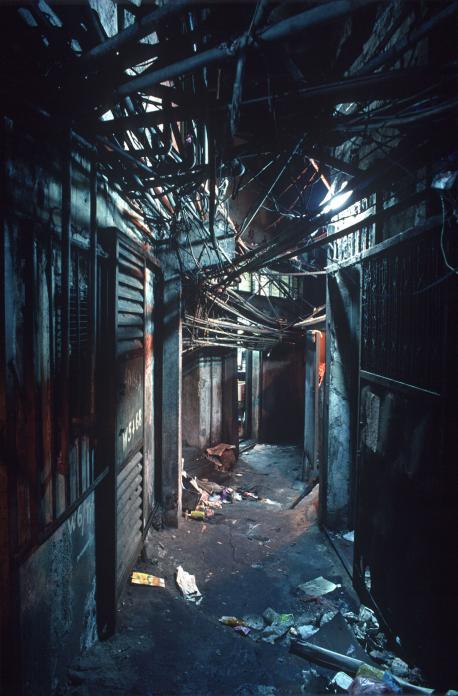
The area was made up of 300 interconnected high-rise buildings, built without an architect’s planning. The result was a massive forest of buildings harboring a maze of narrow dark passageways with constant dripping from piping above. Many apartments were windowless. Having no other space, the rooftops only place to breathe fresh air and escape the claustrophobia of the city - even a place for children to play.
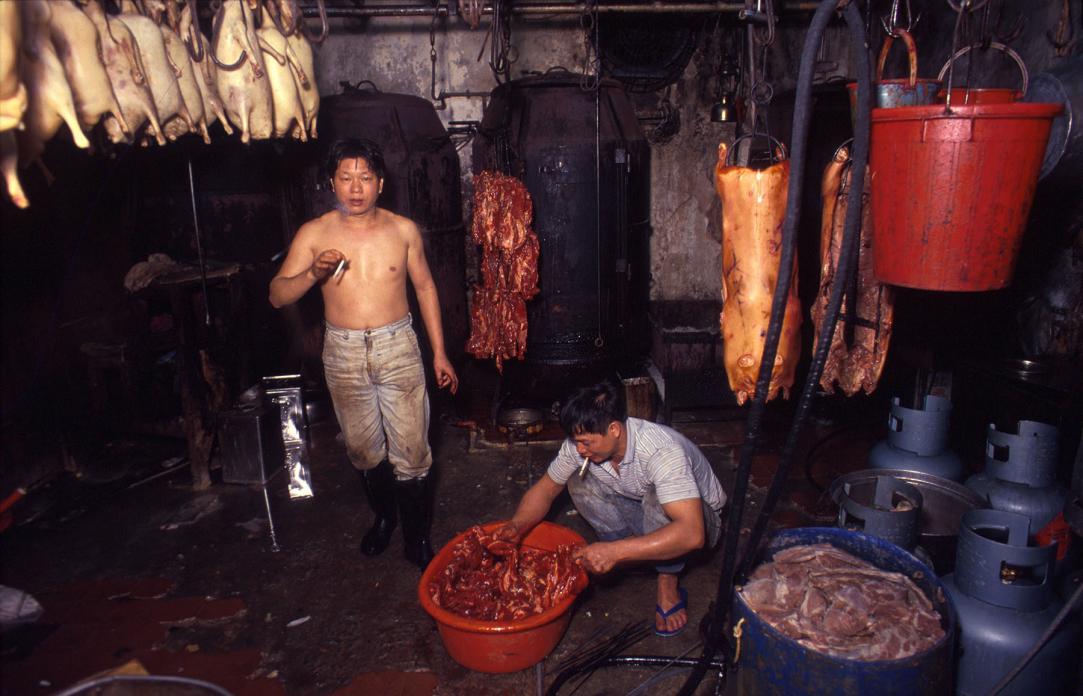
http://www.greggirard.com/content/gallery/girard_kowloon010.jpgThe city was anarchic in its architecture and citizens. Without govermental health and sanitation inspectors, the city attracted sloppy food processors, unlicensed doctors and dentists as well as criminals.

Walled City became a haven for crime and drugs, despite its small area hosting countless brothels, gambling parlors, and opium dens.
Until 1974 the city was run by the Chinese Triads until 1974 with police only venturing in large groups into the city. From 1973-74 on, subsequent police raids helped in cutting back the Triads' power and reducing the crime rate. In 1983, crime was declared to be under control.

http://www.greggirard.com/content/gallery/girard_kowloon011.jpg
Most residents were not involved in any crime and lived peacefully within the Walled City, forming a tightly knit community to help each other and improve daily life there. While sanitary conditions and fire prevention did never achieve an acceptable standard, many other interactions worked surprisingly well in a self-organizing way. Numerous small factories and businesses thrived inside the Walled City.
Despite a reduction in the reported crime rate, both the British and the Chinese governments found the City to be increasingly intolerable. The Hong Kong government announced plans to demolish the Walled City in 1987. Despite the possibility of a financial compensation to citizens and businesses, this was not to the delight of some of the citizens. After a long protracted eviction process, demolition began in March 1993 and was completed in April 1994. Today, the area is occupied by the Kowloon Walled City Park.

Thumbnails are based on photos from the Canadian photographer Greg Girard who, in collaboration with book author Ian Lambot, spent five years in Kowloon Walled City to get to know the residents and to learn how it was (self-)organized. Arial view of Kowloon City by Stevage under GFDL 1.2.

Tuesday, April 15, 2014

How the body affects the mind - On the effects of robot configuration on evolved behavior

The design of robotic controllers through evolutionary methods requires making a large number of choices about the experimental setup, which are often left to the expertise or naïveté of the experimenter. Although much attention is normally given to the fitness function or the genotype-to-phenotype mapping determining the robot controller, the robot configuration is often selected with little care. Yet, an ill-defined configuration - in terms of the selected subset of the sensory-motor system, or in the pre-processing of the raw sensor data - may be decisive in determining the failure of the evolutionary process.

Different emerged patterns 
simulated with ARGoS
In our paper "On the effects of the robot configuration on evolving coordinated motion behaviors" we studied the effect of different robot configurations on the ability to evolve efficient behaviors for a swarm robotics system. In this domain, the choice of a good configuration is fundamental as even small details can lead to large differences in the group behavior. To demonstrate the importance of the robot configuration, we test different alternatives and measure the group performance on a bi-objective scale.

The results show that different configurations not only have a strong effect on performance, but they also correspond to behaviors with radically different features concerning the organization of the group.

The following video illustrates three basic behaviors that emerged: wavefront, train and flocking:


For more information, see:

I. Fehérvári, V. Trianni, and W. Elmenreich. On the effects of the robot configuration on evolving coordinated motion behaviors. In Proceedings of the IEEE Congress on Evolutionary Computation. IEEE, June 2013.

Thursday, October 10, 2013

Interactive web resources on Self-Organizing Systems

WATOR Predator-Prey Simulation

WATOR is a simulation of the interaction over time of predator and prey in a small rectangular area
Language: Java (runs in Browser)
http://www.leinweb.com/snackbar/wator/

Fish School and Predator

This is a simulation of a fish school, where each fish tries to align to its comrades, forming a fish swarm after some time.

Language: Scratch (runs in Browser via Adobe Flash)
http://scratch.mit.edu/projects/10734382

Ant Simulator

Simulation of virtual ants looking for food.
Language: Java (runs in Browser)
http://newton-nes.uni-klu.ac.at/~wilfried/ants/


Conway's Game of Life

Interactive cellular automata simulation.
 Language: Java (runs in Browser)
http://www.bitstorm.org/gameoflife/

Foxes and Rabbits Predator-Prey System

Simulation of a small ecosystem involving a fast-breedin prey (rabbits) and predators (foxes) feeding on them.
Language: Scratch (runs in Browser via Adobe Flash)
http://scratch.mit.edu/projects/10699259/

Slime Mold Simulation

Explanation: http://ccl.northwestern.edu/netlogo/models/Slime

Language: Netlogo (runs in Browser via Java)
http://ccl.northwestern.edu/netlogo/models/run.cgi?Slime.651.477

Fireflies

Explanation: http://ccl.northwestern.edu/netlogo/models/Fireflies
Language: Netlogo (runs in Browser via Java)
http://ccl.northwestern.edu/netlogo/models/run.cgi?Fireflies.763.498

Segregation

Explanation: http://ccl.northwestern.edu/netlogo/models/Segregation
Language: Netlogo (runs in Browser via Java)
http://ccl.northwestern.edu/netlogo/models/run.cgi?Segregation.734.460

Twitter Network Analysis

Interactiv webpage for analyzing trends on Twitter. 
 
Language: Javascript
http://truthy.indiana.edu/politics