Thursday, June 16, 2011

Open PhD Position in Complex Systems

It could be you!
We are looking for a PhD student to do research in the MESON (Modelling and Engineering of Self-Organizing Networks) project. We are a highly motivated international team of researchers situated at the Lakeside Science & Technology Park/University of Klagenfurt, Austria. We offer best work conditions, a beautiful campus with a pleasant, intercultural work environment, and a highly competitive salary.
Potential candidates should have a master's degree in computer science, computer engineering, mathematics, physics or related studies and should have skills in creative problem solving, Java programming, the use of the English language and knowledge in at least one of the following subjects:
  • Complex systems, or
  • Machine Learning, or
  • Multi-agent systems, or
  • Robotics
Research will be conducted at the Institute of Networked and Embedded Systems under the supervision of Wilfried Elmenreich. Working language is English. The institute cooperates with national and international partners from industry and academia and is part of the research cluster Lakeside Labs. Further information about the MESON project can be found on the project webpage. Women are especially encouraged to apply. Please mail applications containing a letter of interest, curriculum vitae, copies of academic certificates and courses, list of publications, and contact details of two references in a single PDF file to applications@lakeside-labs.com by deadline of Juli 31st, 2011.

Saturday, May 28, 2011

Cake paradox resolved - an excursion into Game Theory

In the last posting we elaborated the cake paradox. In short, if we agree to bring in a cake on any day within the following week, Friday (the last day) is not a good choice, because then, the people can predict this already after there was no cake until Thursday. Iterating this argument we end up that no day is good for a surprise.

Actually, we need to clarify certain things in the model here. First, a situation where one is expecting a cake, but it is not brought is also a kind of surprise, though a disappointing one.
Second, if the colleagues are forced to choose one day, the odds are simply 1 out of 5 to guess the day right. Waiting until Thursday to place the bet does not help the guesser here, because in this case you have a high chance to have already lost because the cake was brought before.

However, the game becomes interesting, if the colleagues get the possibility to put a bet on a day at any time before that day but making betting optional. So if you are a cautious person, you might not bet at all, or would wait until Thursday evening, and place the sure bet in case the was not brought before. What is the best strategy for this set up?

Let's look at the payoff table for a situation where only Thursday and Friday are left, the cake has not been brought in yet and no bet was made so far. Player A has to bring in the cake, while player B tries to place the bet.

Player A brings cake on Thursday Player A brings cake on Friday
Player B places bet on Thursday (-1,1) Player B guessed it right (1,-1) Player B guessed it wrong
Player B waits and eventually places bet on Friday (0,0) No bet was placed, game is over (because cake is there) (-1,1) Player B guessed it right

This situation has no pure-strategy Nash Equilibrium. For the best mixed strategy, Player A should chose Thursday with a probability of 2/3, otherwise Friday. In contrast, Player B's best strategy is to bet on Friday with a probability of 2/3. The expected payoff for Player A is then -1/3, which means an advantage for B.

Now we can set up a payout table for the "Wednesday or Later" game. The "Later"-Payoff in the case that neither the cake has been brought yet nor Player B has used her bet so far is the 1/3 derived from the previous payout table.

Player A brings cake on Wednesday Player A brings cake later
Player B places bet on Wednesday (-1,1) Player B guessed it right (1,-1) Player B guessed it wrong
Player B waits (0,0) No bet was placed, game is over (because cake is there) (1/3,-1/3) Game defaults to previous situation

This way we can iterate the game until we end up on Monday. Assuming optimum mixed strategies, the best strategy for Player A to bring in the cake calculates to
16/31 for Monday
8/31 for Tuesday
4/31 for Wednesday
2/31 for Thursday
and 1/31 for Friday.

The guessing player has the same probabilities but increasing from 1/31 for Monday until 16/31 for Friday because the chances favor the guesser towards the end of the week. These mixed strategies establish a Nash equilibrium, thus none of the players has a benefit on changing the strategy. In overall, the game slightly favors the guesser, who is expected to win 3% more often.

Now, we earned ourselves a cake - bon appetit!

Tuesday, May 17, 2011

The cake paradox

There will be cake today
At the institute we have a (recent) tradition to bring home-made cake for the group. Each co-worker is assigned one week within he or she can freely choose one workday to bring the cake. So the actual day when there is cake will be a surprise to the others.
Unless... there is one problem when the process is viewed from a logical perspective.
Consider me having made a cake and planning to bring it in on Friday. Friday is the last workday in the week, so the others could predict the cake to be brought on Friday as soon as they see on Thursday that there is no cake. So I will not choose Friday, because it won't be a surprise on that day.
However, assuming totally logical actors, also Thursday is not an option, since the others will come to the same conclusion that Friday is off the list and they would know on Wednesday evening, when no cake appeared so far, that I will bring it on Thursday. So Thursday is not a surprise day either. We can iterate this argument and end up with the interesting situtation that I have to bring the cake on Monday, since all other days would not be a surprise. Having decided that even Monday is no surprise either.
So it looks like that it is impossible to bring a cake on a weekday as a surprise if everybody knows that I have to bring a cake within this week.
The paradox is interesting but it is also obvious that there is a difference between totally logical and natural actors. Asking people, they usually agree on the argument that Friday would be no surprise, but every other day would be. What do you think?

If you like this kind of puzzles, I recommend the book of Zbigniew Michalewicz and his son on Puzzle-Based Learning.

Thursday, April 28, 2011

Humanity is executing an evolutionary algorithm

One interesting aspect of humans is that they very strongly tend to copy the behavior of famous and admired individuals, a behavior that can also be found for our close relatives, the chimpanzees.
Actually, most of our behavior is based on previous experience and 'aping' others. There are actual very few situations where we use a pure deductive approach to solve a task. Wanna kick a curve ball? You can go for the deductive approach, but you will end up in a complicated physical air flow model. Better watch the neighbor’s boy doing it, and copy the movement.
The reason for this is that we live in a complex world, where the deductive approach usually fails because we cannot build accurate models. You want to start a business on the main street of your town? You would most likely fail trying to build an accurate economic model of your customers without taking into account the experience of people who already had a similar business in a comparable situation.
This leads us to two conclusions:
(i) Looking at whole humanity, we can see that they are executing an evolutionary algorithm, where behavior is inherited from successful individuals and modified to test new hypotheses or to adapt to new situations
(ii) Our intellectual abilities are mainly used to estimate effects of some moderate parameter changes - in evolutionary algorithms, this approach is known of modeling an approximation of the fitness landscape to reduce the number of erroneous trials
So, next time you are at a zoo, don't be too proud of your intellectual abilities - the main mechanism that lets humanity survive in a complex world is copying behavior as part of a giant evolutionary algorithm!

Friday, April 8, 2011

Logo turtle graphics

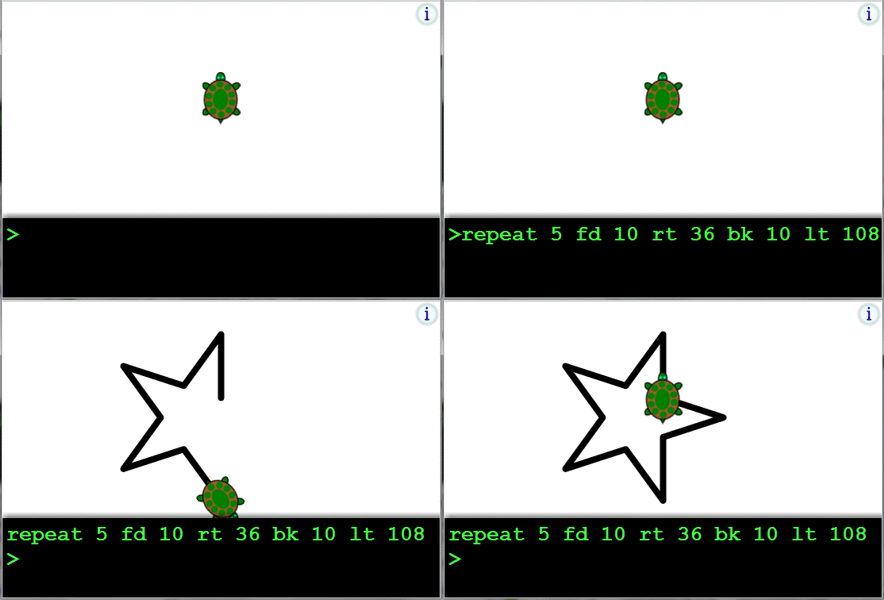
Logo is a venerable functional programming language (created 1967) which gained most of its popularity from the concept of Turtle Graphics: A small triangle on the screen (the turtle) being directed by simple commands like forward, backward, left, and right, each command followed by an argument giving the distance or turning angle.
In combination with the repeat command you could create beautiful drawings with a few commands. Being that simple, the turtle graphics of Logo is a nice way to teach the concept of programming to kids, possibly even pre-school.
The following animation shows a short demonstration of a browser-based Turtle Graphics interpreter aimed at introducing kids to computer programming. I extended the original program from John Villar by a few features. Feel free to click on it and create some nice drawings!

Click on this image to start Turtle Graphics in your browser

Another interesting aspect of turtle graphics is the agent-centric view: you need to specify movements and actions from the perspective of the turtle. For example, the effect of the forward command depends on the current heading of the turtle. This is fundamental different from most other programming languages where you draw on a canvas using absolute coordinates.
That such an agent-centric view is beneficial for modeling self-organizing systems has also been shown by the agent-based simulation language StarLogo, which is a multi-agent extension of Logo. If you are interested to use turtle graphics in education on multi-agent and decentralized systems, have a look at StarLogo.

Thursday, April 7, 2011

Lakeside Research Days 2011: Applications of self-organization in technology

The concept and theory of complex systems and self-organization has been researched for several decades and yielded many publications. Scientists claim self-organization to be the new paradigm to cope with the emerging complexity of networked applications. However, the claimed paradigm change has not yet shown a very great impact so far. Typical applications which are claimed to implement and build on self-organization are often built by experts from the respective domain such as computer networks, wireless communications, sensor networks, etc. without generality that holds also for other domains. On the other hand, research and development on applications of self-organization have the potential to provide results across the particular domain borders. In order to enable this potential, there is a need to move the application area of self-organizing systems more towards the center of complex systems research. In other words, complex systems researcher need to learn how to apply their results and domain specific researchers need to learn more about the general aspects of self-organization. At the Research Days 2011, a group of internal researchers will discuss how this translation between complex systems theory, domain-specific theory, and practical application can be achieved.
The Research Days are an annual event concentrating on the core competence of Lakeside Labs - Self-organizing Networked Systems. During this workshop organized by Lakeside Labs GmbH in cooperation with the University of Klagenfurt, international experts devote themselves to a special topic in self-organization. The event is organized as a five days workshop in July. It takes place at Lakeside Labs in Klagenfurt am Wörthersee, Austria, near a beautiful lake and Alps scenery. Invited experts, local professors, and young researchers discuss and elaborate ideas in the field of Self-Organizing Systems (SOS). The main emphasis of the workshop is on soliciting discussions and creating new ideas regarding a topic related to self-organizing systems. The event greatly supports scientific exchange, networking, establishment of international collaborations, and joint research projects.
The following video gives a nice impression of the Research Days:


The Research Days 2011 will take place in the week of July 11-15, 2011. Please visit http://researchdays.lakeside-labs.com for further information.

Friday, April 1, 2011

iBraitenberg

Braitenberg robot approaching a light source
A Braitenberg vehicle is a simple robot that is able to show interesting complex behavior. The main feature of a Braitenberg vehicle is that it lacks a complex controller but instead directly connects the sensors' output to some actuators' input. That way, a two-wheeled vehicle can, e.g. be told to approach or to flee from an object detected by the sensors. Dominik Egarter has build a nice Braitenberg vehicle using Lego mindstorms. To be exact, it is a Braitenberg emulator contained in the Lego Mindtstorms controller brick. The interesting feature is that the vehicle can be configured via a nice iPhone app. The iBraitenberg app is a useful demonstrator to introduce robotics to pupils. We presented the work at an open lab day at the university, where the project attracted a lot of people, among them several kids.


Movie explaining the vehicle and demonstrating the iBraitenberg app.